











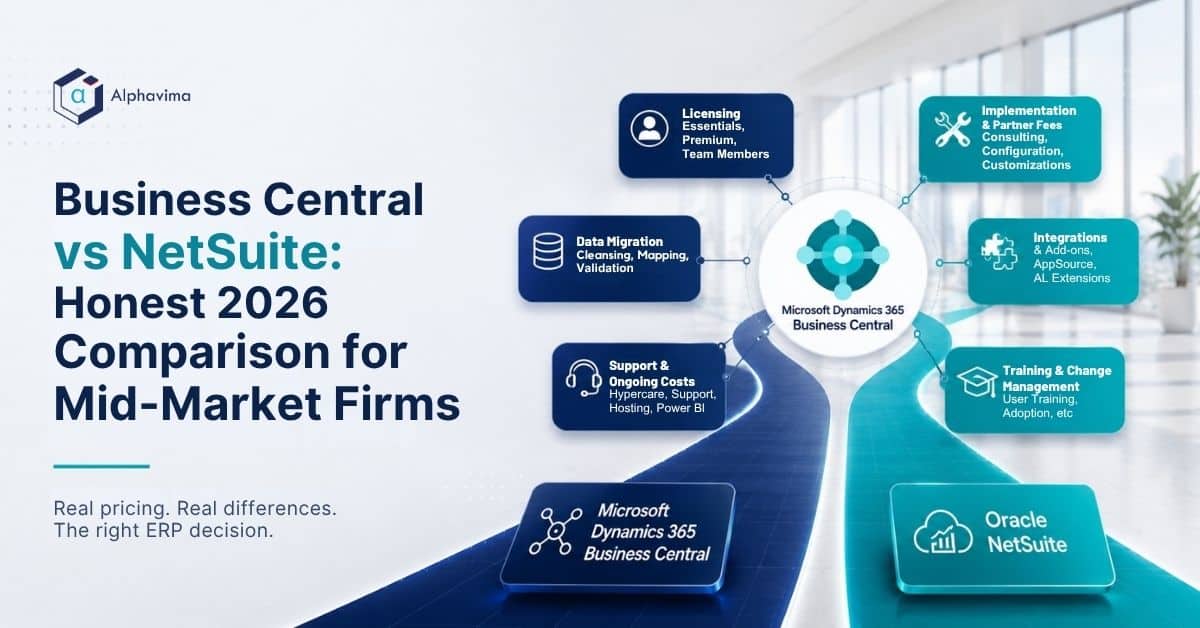
When mid-market companies evaluate ERP, two cloud-native platforms consistently appear at the top of the shortlist: Microsoft Dynamics 365 Business Central and Oracle NetSuite. Both are proven SaaS ERP systems with strong financials, supply chain, and reporting capabilities.
The decision between them comes down to a handful of strategic factors — and for companies already embedded in Microsoft’s ecosystem, Business Central increasingly wins that comparison.
This guide provides an honest, detailed comparison of Business Central and NetSuite across the dimensions that matter most to mid-market decision-makers.
Table of contents
At a Glance: Business Central vs NetSuite
| Dynamics 365 Business Central | Oracle NetSuite | |
|---|---|---|
| Vendor | Microsoft | Oracle |
| Market segment | SMB to mid-market | SMB to mid-market (international) |
| Deployment | Cloud (SaaS) or On-Premises | Cloud (SaaS) only |
| Pricing model | Per user/month | Annual subscription (SuiteSuccess packages) |
| Microsoft 365 integration | Native | Third-party connectors |
| Power BI integration | Native embedded | Third-party |
| Power Automate | Native | Third-party |
| Teams integration | Native | None |
| Manufacturing module | Yes (Premium) | Add-on (WMS/Manufacturing) |
| Multi-currency | Yes | Yes (strong) |
| Multi-subsidiary | Yes | Yes (strong) |
| Copilot AI | Yes (growing) | Limited |
| AppSource extensions | 4,000+ | SuiteApp marketplace |
Pricing Comparison
Business Central
- Essentials: ~£57/user/month — Finance, Supply Chain, Sales, Projects
- Premium: ~£82/user/month — Adds Manufacturing and Service Management
- Team Members: ~£6/user/month — Read-only access for light users
Implementation costs: £30,000–£200,000 depending on scope.
NetSuite
NetSuite pricing is not publicly listed and is negotiated per contract. Published estimates: – Base platform: $999/month base + $99/user/month (before discounting) – Advanced modules (Manufacturing, WMS) carry additional fees – SuiteCommerce, SuitePeople (HR), and SuiteAnalytics are add-on costs
In practice, NetSuite Total Annual Contract Value for mid-market companies typically falls between £40,000–£120,000/year depending on modules and user count — often 40–80% higher than equivalent Business Central licensing.
Implementation costs: £50,000–£300,000 for SuiteSuccess packages.
Feature Comparison Deep Dive
Financial Management
Both platforms provide strong core financial management. Key differences:
Business Central advantages: – Native integration with Microsoft 365 (post invoices from Outlook, approve expenses in Teams) – Power BI embedded financial dashboards with no additional licence cost – UK Making Tax Digital (MTD) native compliance – Copilot AI for cash flow forecasting and late payment prediction
NetSuite advantages: – Stronger multi-subsidiary consolidation for complex international structures – OneWorld multi-currency revaluation handles complex intercompany scenarios well – SuiteAnalytics provides advanced in-system analytics
Supply Chain and Inventory
Both cover purchasing, sales, and inventory management comprehensively.
Business Central advantages: – Tighter integration with Power Automate for approval workflows and notifications – Assembly orders for configure-to-order scenarios – Warehouse Management System (WMS) included in Essentials — no add-on required
NetSuite advantages: – Demand planning module is more mature for complex forecasting scenarios – Advanced procurement workflows natively included
Manufacturing
Business Central Premium advantages: – Full discrete manufacturing suite: BOMs, routings, production orders, MRP, finite scheduling — all included in Premium – Shop floor integration via API to MES systems
NetSuite: – Manufacturing is an add-on module with additional cost – Less suitable for complex discrete manufacturing compared to Business Central Premium
Microsoft Ecosystem Integration
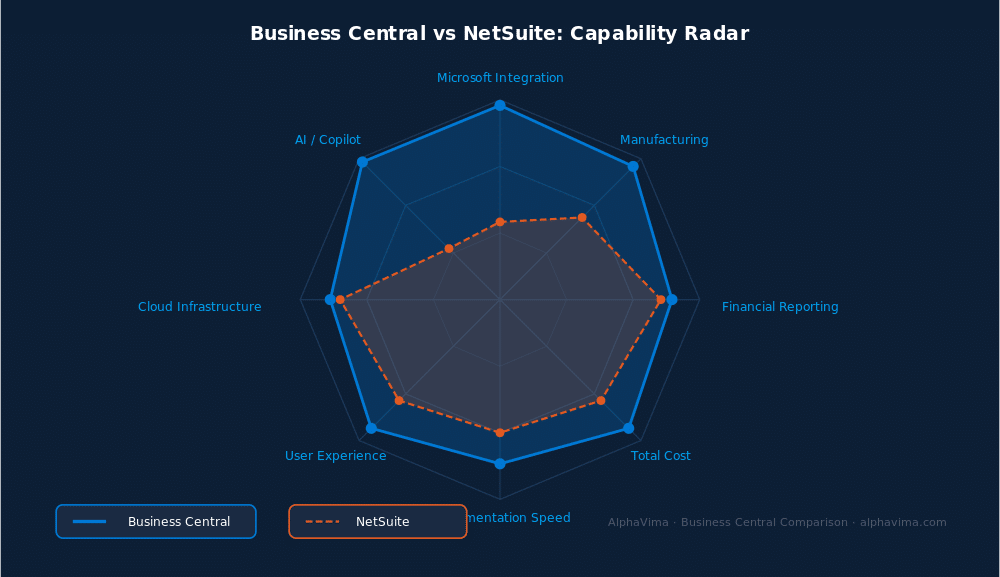
This is where Business Central wins decisively for most mid-market organisations.
Business Central: – Teams: View customer records, approve transactions, and share Business Central pages directly in Teams channels – Outlook: Post invoices, view customer balances, and create contacts from Outlook emails – Excel: Two-way live synchronisation — edit data in Excel and post back to Business Central – Power BI: Embedded dashboards within Business Central; pre-built content packs included – Power Automate: Native connector with hundreds of pre-built templates for approval workflows and notifications – SharePoint: Document management integrated with Business Central records
NetSuite: – No native Teams integration – Outlook connector requires third-party add-on – Power BI connectivity requires custom connector
For organisations that measure productivity through Microsoft 365 adoption, Business Central’s ecosystem integration is a decisive advantage.
When NetSuite Is the Better Choice
To be objective: NetSuite wins in specific scenarios:
- Complex multi-subsidiary international operations: NetSuite OneWorld handles complex intercompany eliminations, multi-GAAP reporting, and currency translation for multi-entity international organisations more robustly than Business Central out of the box
- US-centric mid-market SaaS businesses: NetSuite has a stronger ISV ecosystem for US-focused SaaS and subscription billing scenarios
- E-commerce focused businesses: SuiteCommerce provides an integrated e-commerce platform not available in standard Business Central
- Non-Microsoft environments: Companies using Google Workspace or other non-Microsoft productivity tools get less value from Business Central’s Microsoft integration advantage
Migrating from NetSuite to Business Central
If you are currently on NetSuite and evaluating Business Central, here is what the migration involves:
Data Migration: NetSuite provides data export tools (CSV export, SuiteAnalytics reports) for all master data and transactional data. This exports cleanly to Business Central’s import format.
Integration Rebuild: NetSuite integrations built on SuiteScript or third-party middleware must be rebuilt for Business Central’s API and Power Automate platform.
Customisation Assessment: NetSuite customisations built in SuiteScript do not migrate — assess each customisation against standard Business Central functionality or AppSource alternatives.
Timeline: A typical NetSuite-to-Business-Central migration takes 16–24 weeks depending on customisation volume and integration complexity. See our guide on Business Central Power Automate integrations for integration rebuild considerations.
Get an honest Business Central vs NetSuite comparison
Bring your user count, your Microsoft footprint and your must-have modules. We will score both against your requirements, not against a brochure.
Conclusion
Business Central and NetSuite are both credible ERP platforms for mid-market businesses. The right choice depends on your organisation’s specific needs, existing technology investments, and strategic direction.
For companies embedded in Microsoft 365 — and that is the majority of UK and European mid-market businesses — Business Central’s native ecosystem integration, transparent pricing, and growing AI capabilities make it the stronger platform choice. For complex multi-entity international businesses without a Microsoft-centric technology strategy, NetSuite remains a competitive option.
Whatever platform you choose, the quality of your implementation partner matters as much as the software. A structured approach, clean data migration, and comprehensive training are the difference between a successful ERP deployment and a costly failure.
Comparing your ERP options? AlphaVima’s ERP advisory team can help you build a structured evaluation and make the right platform decision for your business. Contact us for an independent ERP assessment.
Currently on NetSuite and evaluating your options? Leave a comment or get in touch — we’d be happy to share more detail on your specific scenario.
Frequently asked questions
Is Business Central cheaper than NetSuite?
In most mid-market scenarios, yes — Business Central is 30–60% less expensive than comparable NetSuite configurations. Business Central's pricing is transparent and publicly listed; NetSuite's pricing is negotiated and module-based, which often results in higher total cost than initial quotes suggest. For an accurate comparison, request a like-for-like quote from both vendors for your specific user count and module requirements.
Does Business Central support multi-subsidiary and multi-currency as well as NetSuite?
Business Central supports multi-company, multi-currency, and intercompany transactions natively. For most mid-market multi-entity organisations, Business Central's capabilities are sufficient. NetSuite OneWorld has a more mature multi-subsidiary consolidation engine for very complex international structures with many intercompany relationships. If your organisation has more than five legal entities with complex intercompany eliminations, evaluate both platforms carefully.
Can I migrate from NetSuite to Business Central without losing my data?
Yes. NetSuite's data export tools allow export of all master data (customers, vendors, items, chart of accounts) and open transactional data. Historical transaction data can be archived in NetSuite or exported to a data warehouse for ongoing reporting. The migration process follows the same structured approach as other ERP migrations: export, cleanse, transform, and import.
Which has better manufacturing capabilities — Business Central or NetSuite?
Business Central Premium has superior discrete manufacturing capabilities compared to NetSuite's standard manufacturing module. Business Central's full manufacturing suite — BOMs, routings, MRP, capacity planning, finite scheduling — is included in the Premium licence. NetSuite's manufacturing is an add-on module with additional cost and less comprehensive capabilities for complex production environments.
How does Business Central compare to NetSuite for financial reporting?
Both provide strong core financial reporting. Business Central's major advantage is native Power BI integration, which provides significantly more flexible and visually rich reporting than NetSuite SuiteAnalytics. NetSuite's SuiteAnalytics is a capable in-system tool, but Power BI's visualisation capabilities and data integration options are unmatched. For organisations investing in data-driven decision-making, Business Central plus Power BI is typically the stronger choice.
Does Business Central support SaaS/subscription billing like NetSuite?
Standard Business Central does not include a subscription billing module. For SaaS companies or subscription businesses, Microsoft AppSource offers subscription management ISV extensions such as Subscription & Recurring Billing (LS Retail), which add this capability. NetSuite's SuiteBilling is a more mature, natively integrated subscription billing solution. For subscription-heavy businesses, this is a genuine NetSuite advantage.
What does Business Central's Copilot AI offer compared to NetSuite?
Business Central's Copilot features (as of 2025) include cash flow forecasting suggestions, late payment prediction, bank reconciliation AI matching, and marketing text generation for items. Microsoft is actively expanding Copilot throughout Business Central with each bi-annual release. NetSuite's AI capabilities are less developed at this stage. For organisations planning to leverage AI in their ERP, Business Central's roadmap is more compelling.
Is implementation faster for Business Central or NetSuite?
Business Central implementations typically complete in 12–20 weeks for standard mid-market scope. NetSuite SuiteSuccess implementations are structured around pre-configured industry templates that can accelerate initial go-live, but mid-size implementations often take 16–24 weeks. AlphaVima's Business Central methodology is optimised for mid-market speed-to-value with defined scope and fixed-price options.