










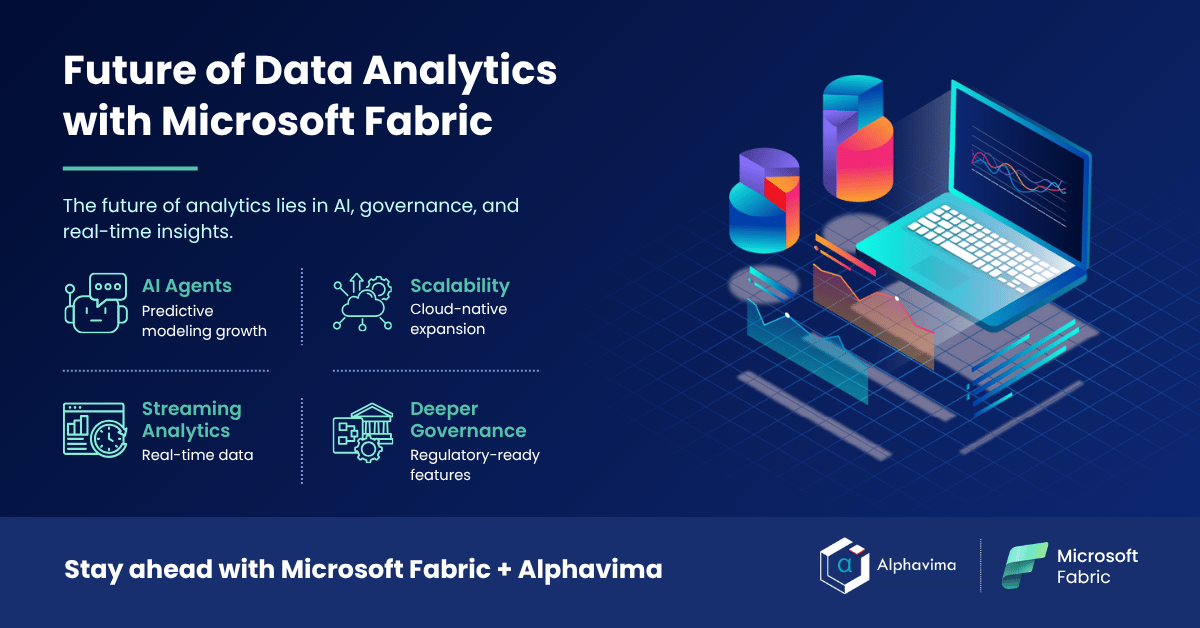
You’re no longer waiting for Monday morning to check last week’s reports. With the right setup, you act the moment insight appears. That’s what modern analytics demands: AI-powered processes, built-in governance, live data flows – and that’s where Microsoft Fabric steps in. This unified platform brings intelligence, compliance and real-time dynamics together so your data truly works for you.
1. AI Agents → Predictive modelling growth
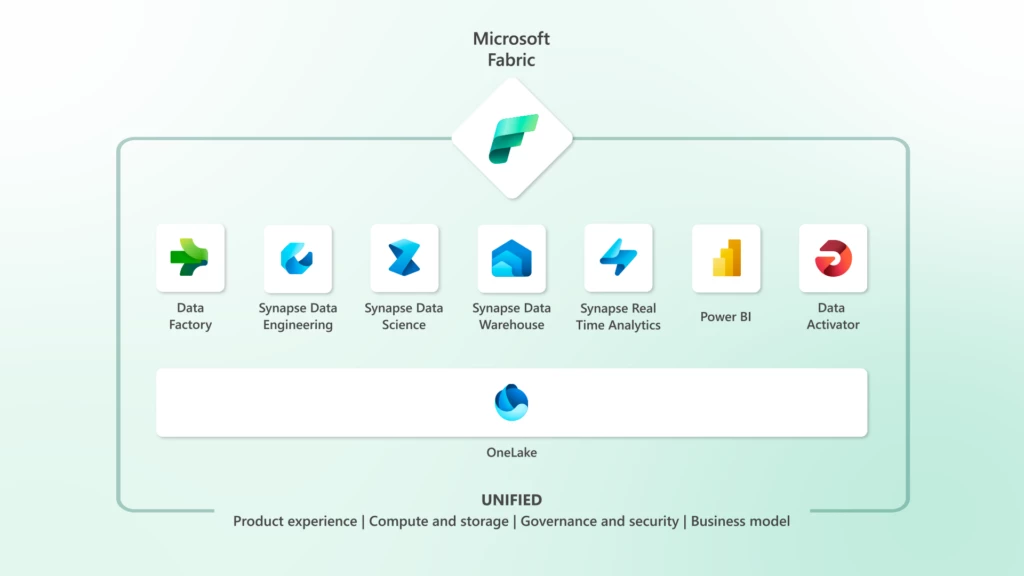
Imagine if your analytics platform not only told you what happened but what will happen and even what to do. Microsoft Fabric plugs AI agents straight into the analytics workflow. According to Microsoft, Fabric is “an enterprise-ready, end-to-end analytics platform … from collecting and processing data through building reports and dashboards.”
Key points to highlight:
Fabric supports role-specific workloads for data engineering, data science, analytics and databases, all in one place.
Its built-in AI and support for models mean you can shift from descriptive (“what happened?”) to predictive (“what’s likely?”) and prescriptive (“what should we do?”).
For service providers like you (via Alphavima), this means you can show clients that analytics isn’t just hindsight – it’s foresight.
Takeaway for your readers: when you adopt Fabric, you’re not just visualising data – you’re making it smart, active and decision-ready.
2. Streaming Analytics → Real-time data
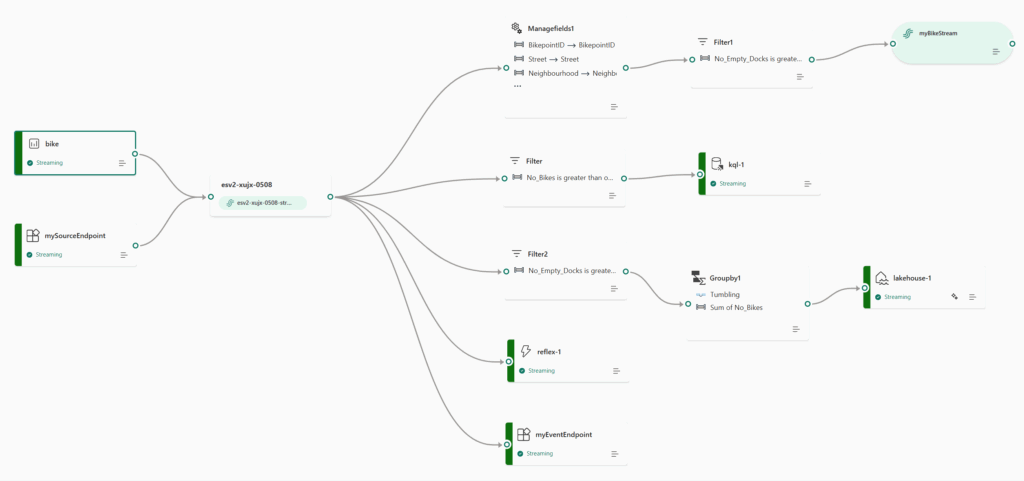
The advantage goes to the organisation that knows now, not just next week. Fabric’s streaming analytics capability means data in motion becomes insight in motion. Its Real-Time Intelligence workload enables ingesting, transforming and analysing event and sensor data as it arrives.
Important angles:
-
You can capture streams from sources like IoT devices, applications, logs – and turn them into actionable insight almost immediately.
-
Fabric’s unified platform means you don’t have to build separate systems for streaming vs batch – everything lives in the same environment.
-
From a services perspective: this opens use-cases such as operational monitoring, anomaly detection, customer-behaviour triggers.
-
Reader takeaway: Real-time analytics isn’t a “nice to have” anymore – it’s becoming standard if you want to maintain advantage.
3. Deeper Governance → Regulatory-ready features
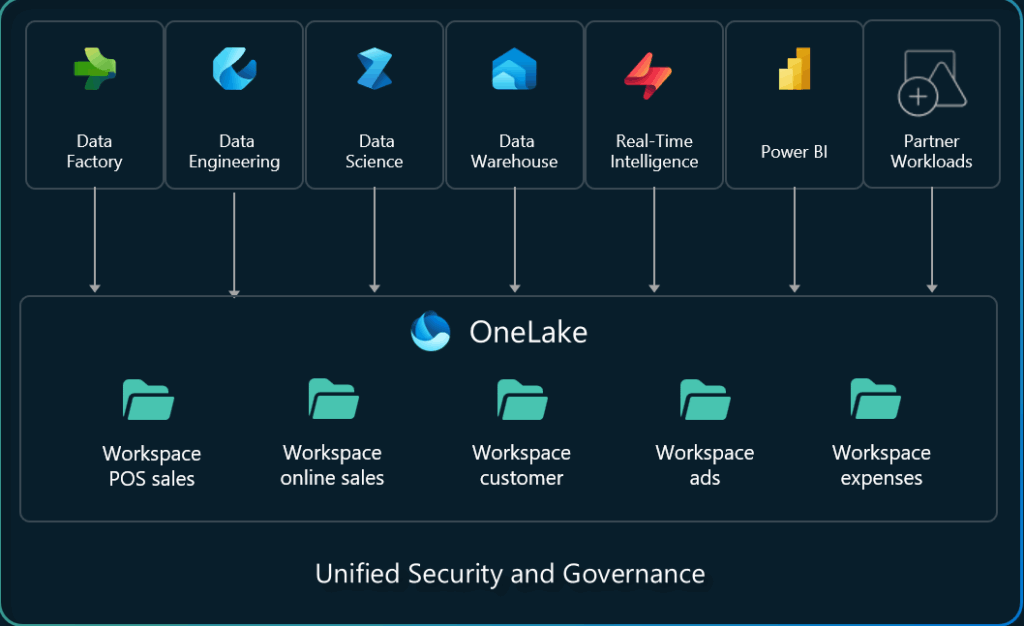
When analytics spreads across every part of the business, governance and compliance can’t be afterthoughts – they must be built-in. Fabric addresses this by layering governance, data-lineage, metadata and unified storage into the platform.
Key themes:
-
The platform’s lake-centric architecture (via OneLake) means you avoid multiple silos, duplication, inconsistent policies – leading to better control.
-
From a service stance: you can tell clients you’ll help not only build analytics – but build it the right way, with audit trails, role-based access, data sensitivity labels.
-
For the reader: Strong governance means you scale analytics without exposing yourself to risk. It’s part of trust, resilience and enterprise-grade operations.
4. Scalability → Cloud-native expansion
Insights matter – but only if your platform keeps up with your growth. Fabric is designed from the ground up for scalability – both in data volume and complexity.
Highlights:
-
Fabric is a SaaS platform that brings together data storage, processing, analytics – so you don’t have to stitch multiple services and worry about capacity gaps.
-
Whether you start with a small analytic project or expand to enterprise-scale real-time analytics across geographies, the platform supports it.
-
From your services side: position that you help clients build with future growth in mind – not just solve today’s problem but be ready for tomorrow’s.
-
Reader takeaway: Scalability is less about “big data” and more about “growing smoothly, without doubling the complexity”.
Closing Summary
Analytics is no longer a scoreboard – it’s a real-time decision engine. With Microsoft Fabric, you bring together AI-driven modelling, live data streams, built-in governance and true scale. For organisations and service providers alike, the opportunity is clear: adopt a platform built for what’s coming and implement services that unlock its full potential. At Alphavima, we’re ready to guide you – whether you’re starting from scratch or modernising your data estate.
Ready to unlock smarter insights with Microsoft Fabric?
Take the next step toward smarter, connected data analytics with Microsoft Fabric.
FAQs
What is Microsoft Fabric in data analytics?
Microsoft Fabric data analytics is a unified, end-to-end platform. It combines data ingestion, storage, governance, and visualisation in a single environment. As a result, teams no longer need to stitch together separate tools for warehousing, BI, and pipelines. Through OneLake, a single data lake underpins every component. Therefore, organisations gain a consistent foundation for all their analytics work. For businesses managing complex data estates, this approach reduces overhead and accelerates time to insight. Read the official Microsoft Fabric overview in the Microsoft documentation.
How does Microsoft Fabric use AI for analytics?
Microsoft Fabric integrates AI models directly into analytics workflows. This enables predictive and prescriptive insights without leaving the analytics environment. Data scientists and analysts can use built-in Copilot capabilities within Fabric notebooks, Power BI reports, and data pipelines. As a result, the barrier between raw data and actionable predictions becomes much lower. Additionally, advanced AI becomes accessible to business users who lack deep data science expertise. Consequently, teams benefit from faster decision cycles and more proactive use of organisational data.
Why is governance important in Microsoft Fabric?
Fabric includes built-in data governance, lineage tracking, and compliance tools. These ensure data accuracy and accountability across the enterprise. With OneLake as the central data store, organisations can enforce access controls and monitor data movement. Furthermore, they can maintain a full audit trail for regulatory requirements. In particular, governance is embedded at every layer of the platform rather than added as an afterthought. Therefore, data teams spend less time on manual compliance tasks and more time on delivering insights.
Is Microsoft Fabric suitable for real-time analytics?
Yes, Fabric's Real-Time Intelligence features let users capture, process, and visualise streaming data with low latency. EventStream and KQL databases enable organisations to act on live data from IoT sensors, web logs, and financial feeds. In addition, these tools support high-velocity sources common in retail, logistics, and financial services. As a result, teams can respond to events as they happen rather than waiting for batch processing cycles. This real-time capability is especially valuable when the timeliness of insights directly affects business outcomes.
How can Alphavima help implement Microsoft Fabric?
Alphavima provides consulting, configuration, and integration services to help businesses deploy Microsoft Fabric data analytics for modern enterprise workloads. From initial assessment and architecture design to migration from legacy data warehouses, our team guides organisations through every phase of adoption. Our certified specialists also help connect Fabric to existing Power Platform investments. Explore our Power Apps development services in Toronto, Microsoft Copilot Studio consulting, and nonprofit CRM solutions to see the full range of support we offer.