



Alphavima India

Alphavima
Microsoft Solutions PartnerMicrosoft Dynamics 365Dynamics 365Customer EngagementMicrosoft Copilot

Home/Dynamics 365/ERP

Microsoft ERP for India

Microsoft Dynamics 365 ERP in India

Dynamics 365 ERP comes in two sizes: Business Central for growing SMEs and mid-market firms, and Finance and Supply Chain Management for larger, multi-entity groups. We help you pick the right one and implement it with Indian compliance built in.

A clear choice between Business Central and Finance and Supply Chain ManagementGST, TDS, TCS and e-invoicing set up in either productImplementation, migration, integration and support from one certified team

Microsoft Solutions Partner for AI Business Solutions (formerly Business Applications) and Modern Work. ISO 27001 and ISO 9001:2015 certified.

20+

years in business

100+

Microsoft-certified consultants

100+

clients globally

97%

client satisfaction

Two Microsoft ERPs

Dynamics 365 ERP: Business Central or Finance and Supply Chain Management

Microsoft’s Dynamics 365 ERP family has two routes. Business Central runs finance and operations for small and mid-sized companies. Dynamics 365 Finance and Supply Chain Management serve larger groups with many entities, sites and complex production.

Turnover alone rarely decides it. Three things do: how many legal entities and GST registrations you run, how complex your manufacturing and warehousing are, and how many people and transactions the system must carry.

Both run on the same Microsoft cloud, with Microsoft 365, Power BI and Copilot around them, and both ship with Microsoft’s India localisation for GST, TDS and TCS. So a company that starts on Business Central keeps a clear path upward, and the way you design your chart of accounts, dimensions and master data now is what makes that path easy later.

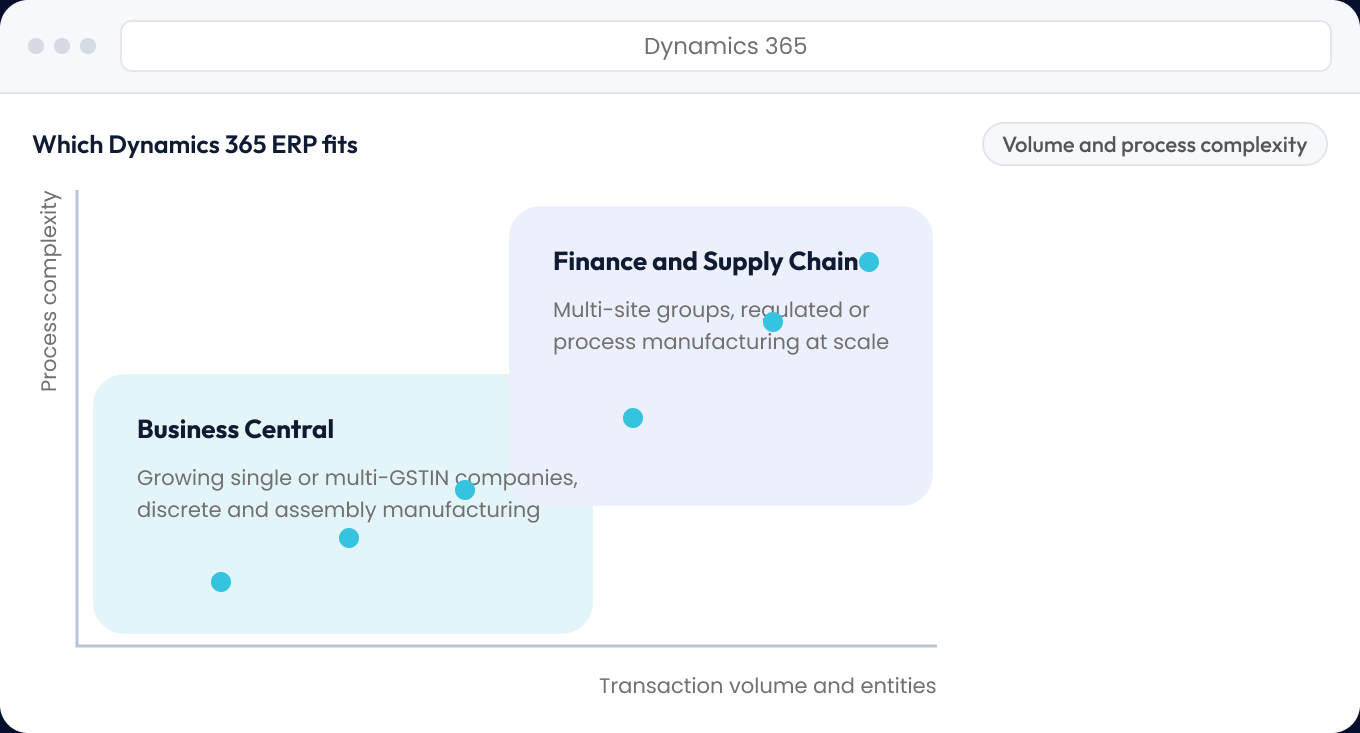
Most growing Indian businesses moving on from Tally, Zoho or Busy land in the Business Central zone below. Groups with several manufacturing sites, regulated process production or shared services across countries land in the Finance and Supply Chain Management zone. The overlap in the middle is real, and it is what a discovery workshop settles.

PROCESS COMPLEXITYTRANSACTION VOLUME AND ENTITIESRegulated process, one siteMulti-site, regulated, high volumeAccounting-led, one or few GSTINsHigh volume, straightforward processBusiness CentralGrowing single and multi-GSTIN companiesFinance and Supply ChainMulti-site and multi-country groupsOverlapSettled in discovery

Business Central sits where transaction volume and process complexity are moderate: one to several legal entities and GST registrations, discrete or assembly manufacturing, and warehousing with bins and lot tracking. Dynamics 365 Finance and Supply Chain Management sit where both rise: many entities across states and countries, multi-site or regulated process production, and enterprise-scale volumes. Companies in the overlap can go either way, and the choice is settled in a discovery workshop rather than by turnover.

Side by side

Business Central vs Finance and Supply Chain Management

Go through these eight questions with your finance and operations leads. Where most of your answers sit at the top of the scale, Business Central is your starting point. Where several sit at the bottom, plan for Finance and Supply Chain Management.

Four dots means Business Central covers the requirement as standard for companies at this stage. Three means it covers it and we configure it for your set-up. Two means you are at the point where Dynamics 365 Finance or Supply Chain Management is usually the better answer. The note on the right says what those products do with the same requirement.

One to several legal entities and GSTINs

Intercompany postings and consolidation are built in. Many entities across states and countries: Dynamics 365 Finance

Discrete and assembly manufacturing

BOMs, routings, MRP and capacity in Business Central Premium. Also built into Supply Chain Management

Formula and batch process manufacturing

Extended with AppSource add-ons such as BatchMaster or Aptean. Formulas, batches and quality are native in Supply Chain Management

Warehousing: bins, put-away and picking

Locations, bins, lot and serial tracking. Advanced, high-volume warehouse management: Supply Chain Management

India GST, TDS and TCS

Microsoft India localisation, in Business Central and in Finance and Supply Chain Management alike

Subcontracting and job work with GST

Challans and returns from vendors are documents in the system. Also handled in Supply Chain Management

Users and transaction volume

Comfortable for growing mid-market volumes. Enterprise-scale posting and planning volumes: Finance and Supply Chain Management

Group budgeting, consolidation and shared services

Multi-company, multi-currency consolidation. Multi-country statutory reporting and shared services: Dynamics 365 Finance

Licensing

Business Central is licensed per user, per month: Essentials from ₹6,655 per user/month, billed annually, GST extra. Dynamics 365 Finance and Supply Chain Management are also per-user subscriptions, and Microsoft confirms the figure for your scope at quote, because it depends on which apps and how many full users you take. See all Business Central plans.

Project shape

A Business Central rollout is a focused project with a named team and a fixed scope agreed after a discovery workshop. Finance and Supply Chain Management are normally delivered as a phased programme, with an internal project team on your side alongside ours. Either way, our proposal shows licences and services as separate lines.

Business Central Essentials list price as published by Microsoft for India, billed annually, GST extra. Microsoft list prices, subject to change; your final price is confirmed at quote.

Inside the products

What a Dynamics 365 ERP actually runs for an Indian business

Both products cover the same ground. They differ in how much depth they carry and how much scale they are built for. These are the three areas buyers ask about most.

Finance, in both products

General ledger with dimensionsIndian financial yearReceivables and payablesBank reconciliationFixed assets, India depreciationMulti-company consolidationShared services and multi-country in Finance

01

Finance, entities and the month-end close

Both products run one ledger with dimensions, so a cost centre, a project and a state are attributes of a posting rather than three separate charts of accounts. That is what lets a group with several companies close once and report by entity, by state and by business line from the same numbers.

Business Central handles a group of Indian entities with intercompany postings and consolidation. Dynamics 365 Finance adds the depth a multi-country group needs: statutory reporting per country, shared service centres, and allocation and budgeting models across a much larger chart of accounts.

02

Stock, warehouse and production

Business Central Premium covers discrete and assembly manufacturing: bills of material, routings, production orders, MRP, capacity and machine centres, with lot or serial tracking from goods receipt to dispatch. Subcontracting and job work run with GST, so a challan is a document in the system rather than a spreadsheet.

Formula- and batch-driven manufacturers in food, pharma and chemicals extend Business Central with specialist AppSource add-ons such as BatchMaster or Aptean, which we evaluate against your process in discovery. Where production is multi-site, high volume or heavily regulated, Dynamics 365 Supply Chain Management handles formulas, batches, quality orders and advanced warehouse management natively.

Operations

BOMs, routings and MRPCapacity and machine centresLot and serial trackingSubcontracting and job workBins, put-away and pickingFormula and batch productionAdvanced warehousing in Supply Chain Management

India compliance

GST on sales and purchasesMulti-GSTIN and multi-stateHSN and SAC codesTDS and TCSE-invoice JSON, IRN and signed QRE-way bill details on invoicesPortal connection through a GSP

03

Indian compliance, whichever product you choose

Microsoft publishes the India localisation for both products. GST on sales and purchases, including CGST, SGST, IGST, cess, reverse charge, SEZ and exports, multi-GSTIN registrations, TDS including 194Q and TCS including 206C(1H), e-invoice JSON with IRN, and e-way bill details on the invoice are all part of the product.

What we set up is your side of it: the tax engine and a GST registration per state, number series per GSTIN, the GSP connection that brings IRNs and signed QR codes back onto the posted invoice, opening balances, and a test of returns data with your chartered accountant before go-live.

This is a product overview, not tax advice. E-invoicing and e-way bill thresholds are set by government notification and change, so confirm what applies to you with your chartered accountant.

Worked examples

Four situations, and the Dynamics 365 ERP each one points to

These are the shapes of business we are asked about most often in India. Pick the one closest to yours.

A distributor outgrowing Tally or Zoho

Two companies, four states, a few hundred invoices a week, and a team that exports to Excel every time it needs a stock or margin view. The books are fine; everything around them is manual. This is the most common starting point we see in India.

Start with Business Central. Finance, GST, stock, purchasing and warehousing in one systemMasters, opening balances and open documents migrate; older transactions stay in an archiveNext step: compare Business Central with Tally, Zoho and Odoo

An engineering or auto-component manufacturer

One or two plants, bills of material several levels deep, routings through machine centres, and job work going out to subcontractors with challans coming back. Planning is done in spreadsheets against a stock figure nobody quite trusts.

Business Central Premium. BOMs, routings, production orders, MRP and capacity, with lot and serial trackingSubcontracting and job work carry GST, so challans are documents in the ERPNext step: ERP for manufacturing in India

A food, pharma or chemicals manufacturer

Recipes rather than bills of material, batch sizes that vary with yield, quality checks at several points, and shelf life and traceability you have to prove to an auditor. The answer here depends on scale more than on sector.

Single site: Business Central extended with a specialist AppSource add-on such as BatchMaster or Aptean, evaluated against your process in discoveryMulti-site or heavily regulated: Dynamics 365 Supply Chain Management, where formulas, batches and quality orders are nativeWe compare both against your plant and recipes before recommending either

A group with many entities and countries

A dozen legal entities, several of them outside India, a shared services team doing payables centrally, and a statutory reporting calendar that runs all year. Consolidation currently happens in a spreadsheet that one person understands.

Dynamics 365 Finance, with Supply Chain Management where production and warehousing need enterprise depthPhased programme, country by country or function by function, with an internal team alongside oursNext step: our implementation approach

Which to choose

Choose the Dynamics 365 ERP that fits your stage

Both are good products. These are the situations where each one is the better answer.

Recommended

Choose Business Central when

You are moving on from Tally, Zoho, Busy or an older ERPYou run one or a few companies across several statesManufacturing is discrete or assembly-basedYou want a focused project with a named team and a fixed scopeYour teams already work in Microsoft 365, Excel and Teams

The starting point for most growing Indian businesses. Business Central in India

Choose Finance and Supply Chain Management when

Your group has many entities or operates in several countriesYou run multi-site, high-volume or regulated process productionWarehousing and planning need enterprise-scale depthStatutory reporting and shared services span countriesYou can staff a dedicated internal programme team

The right answer for larger groups. ERP for manufacturing

If you are genuinely between the two, start with the discovery workshop rather than the licence decision. We look at your entity list, your GST registrations, your production and your data, and write down the recommendation with the reasons behind it. A move from Business Central to Finance and Supply Chain Management later is a new implementation rather than a licence switch, so we design your chart of accounts, dimensions and master data with that path in mind from the start.

Either product

Delivery, support and the pages that go deeper

Whichever Dynamics 365 ERP you choose, the same team sets up your registrations, connects e-invoicing and e-way bills through a GSP, tests returns with your CA, and supports the system after go-live in Indian working hours.

Still comparing with Tally, Zoho or Odoo?

A fair, fact-checked comparison of Business Central with TallyPrime, Zoho, Odoo and SAP Business One, with published list prices, GST and e-invoicing support product by product, and a five-step migration path.

100+

Microsoft-certified consultants

Alphavima holds the Microsoft Solutions Partner designation for AI Business Solutions, and is ISO 27001 and ISO 9001:2015 certified.

ERP implementation services

Discovery, configuration, data migration, testing, go-live and support, from one Microsoft-certified team working Indian hours.

ERP for your industry

How we set up Dynamics 365 for manufacturers, distributors, retailers and professional services firms.

Connect the ERP to Dynamics 365 CRM

Business Central has a built-in integration with Dynamics 365 Sales for customers, items, prices and orders. Finance and Supply Chain Management connect to Sales and other Dataverse apps through dual-write. Either way, quotes start in CRM and tax invoices are raised in the ERP.

How GST and e-invoicing work in Business Central · Migration from Tally, Zoho or Navision · Copilot for Dynamics 365

Lead magnet

Get an ERP fit assessment

Send us your entity list, your states, your production type and what you run today. We come back with a written recommendation and the reasons for it.

Common questions

Choosing between Microsoft ERPs

Questions buyers ask when deciding between Business Central and Finance and Supply Chain Management.

Is Dynamics 365 Finance the same as Finance and Operations?

Finance and Operations was the earlier umbrella name for Microsoft’s enterprise ERP apps. Today they are licensed as separate apps, mainly Dynamics 365 Finance and Dynamics 365 Supply Chain Management, which run on the same platform and share data. Many people still search for them under the older name.

Yes. Both are Microsoft cloud ERPs, and your Microsoft 365, Power BI and Power Platform investments carry across. A move is a new implementation rather than a licence switch, so we design your chart of accounts, dimensions and master data in Business Central with that future path in mind.

No. Microsoft licenses them as separate apps. A services group might run Finance alone, while a manufacturer or distributor usually needs both. We map the modules you need during discovery so you license only what you use.

Dynamics 365 Supply Chain Management handles formulas, batches and quality natively and suits multi-site or highly regulated process plants. Smaller single-site process manufacturers often run Business Central extended with a specialist AppSource add-on. We compare both against your plant, recipes and compliance needs before recommending either.

Business Central supports multiple companies in one environment, with intercompany postings and consolidation. It works well for groups with a handful of Indian entities and GST registrations. When entity count, countries and shared services grow large, Dynamics 365 Finance is usually the better fit.

Business Central has a built-in integration with Dynamics 365 Sales for customers, items, prices and orders. Finance and Supply Chain Management connect to Sales and other Dataverse apps through dual-write, which keeps records in sync in near real time. Either way, quotes start in CRM and tax invoices are raised in the ERP.

Client outcomes

Client outcomes delivered by Alphavima

Selected stories from Alphavima’s global client base in North America and the UK, delivered on the same Microsoft platforms we implement for businesses in India.

01 / 03

Discrete manufacturing

Production planning cycle cut from weeks to days

Production planning rebuilt on Business Central

Confidential client

Business CentralPower AppsPower BI

Wholesale distribution · USA

99%+ inventory accuracy after barcode warehouse management

Barcode warehouse management for a national distributor

Confidential client

Business CentralWarehouse ManagementEDIPower BI

Equipment and fleet distribution · USA

Zero downtime during a full ERP migration, with 100% data integrity validated

ERP data migration and integration

Custom Truck One Source

ETL pipelinesData validation and reconciliation

Next step

Find the right Dynamics 365 ERP for your business

Share your entity count, states, manufacturing type and current system. We will recommend Business Central or Finance and Supply Chain Management, with the reasons written down.