



Alphavima India

Alphavima
Microsoft Solutions PartnerMicrosoft Dynamics 365Dynamics 365Customer EngagementMicrosoft Copilot

Home/Industries/Retail and E-commerce

Retail and e-commerce

Retail ERP software for marketplace and omnichannel sellers

The marketplace pays you a net figure. Somewhere inside it are commission, logistics, returns and TCS, and reconciling that to your own sales is a monthly job somebody does in Excel. That is the retail problem worth solving first.

Marketplace settlement reconciliation, from net remittance back to order levelTCS under GST, returns and credit notes handled as accounting eventsOne stock position across marketplace, D2C and offline channels
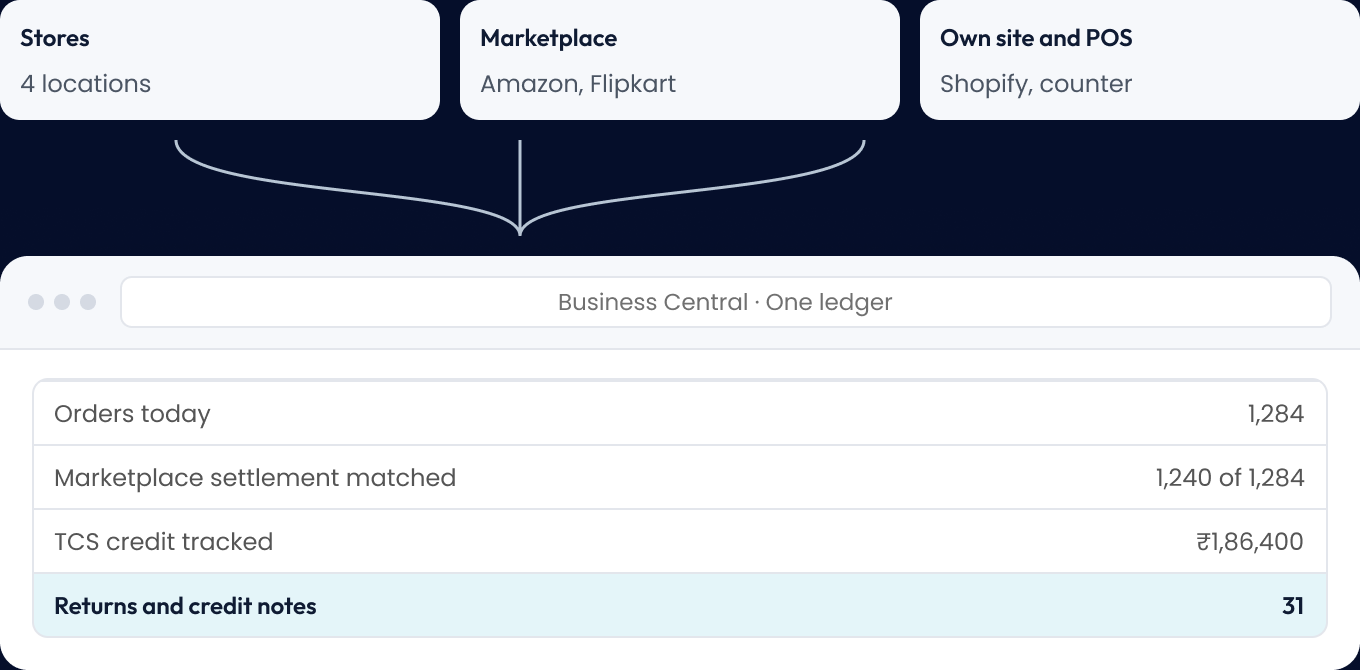

Illustration with sample data

Microsoft Solutions Partner for AI Business Solutions (formerly Business Applications) and Modern Work. ISO 27001 and ISO 9001:2015 certified.

20+

years in business

100+

Microsoft-certified consultants

100+

clients globally

97%

client satisfaction

The actual problem

The marketplace pays you a net figure and does not explain it

Somewhere inside that remittance are commission, fulfilment fees, shipping, penalties, returns and TCS. Reconciling it back to your own orders is a monthly job somebody does in Excel, and until it is done you do not know your margin. That reconciliation is the single most valuable thing retail ERP software can automate for an Indian online seller.

Most retail ERP pages talk about omnichannel. Omnichannel is a word. Settlement reconciliation is a Tuesday afternoon that turns into three days, and it is worth automating first because it is where the money is hiding.

The second thing is stock. One position across marketplace, D2C and offline, with allocation that stops one channel overselling another channel’s inventory.

What actually hurts

The five that come up in every discovery

Settlement reconciliation. Net remittance to order level, with each deduction posted to the right account rather than lumped into one.TCS credit. Collected by the marketplace on supplies it facilitates, and it has to be claimed and reconciled against your own records.Returns. They touch stock, the ledger and the customer record at once, and getting the sequence wrong shows up in the accounts.Stock across channels. One position, with allocation, so a marketplace order does not sell something the store just sold.Multi-state registration. Holding stock in a fulfilment centre in another state is a registration question before it is a logistics one.
What we build for

Four things, and the margin sits underneath all of them

Settlement reconciliation

Order-level matchingComponent postingUnmatched-line reviewMargin by SKU

01

Settlement reconciliation to order level

A marketplace remits a net figure after commission, logistics, penalties, returns and TCS. Reconciling that back to your own order, and posting each component to the right account, is the difference between knowing your margin and estimating it.

02

TCS credit you can defend

Marketplaces collect TCS under GST on the supplies they facilitate, and the credit has to be claimed and reconciled against your own records. What the ERP owes you is a position you can defend: what was collected, against which supplies, and what remains unreconciled.

TCS reconciliation

Collected-by-marketplace trackingCredit claim positionUnreconciled TCS visible

One stock position

MarketplaceD2COfflineChannel allocation

03

One stock position across channels

Usually the second most valuable thing after settlement reconciliation. The hard part is allocation, so one channel cannot oversell what another channel just sold, working from the same figure rather than a nightly export.

04

Returns handled in the right order

A return touches stock, the ledger and the customer record at once, and getting the sequence wrong shows up in the accounts before anyone notices it operationally. Each of the three has to move together rather than being reconciled after the fact.

Returns as accounting events

Stock reinstatedLedger updatedCustomer record synced

How the channels connect

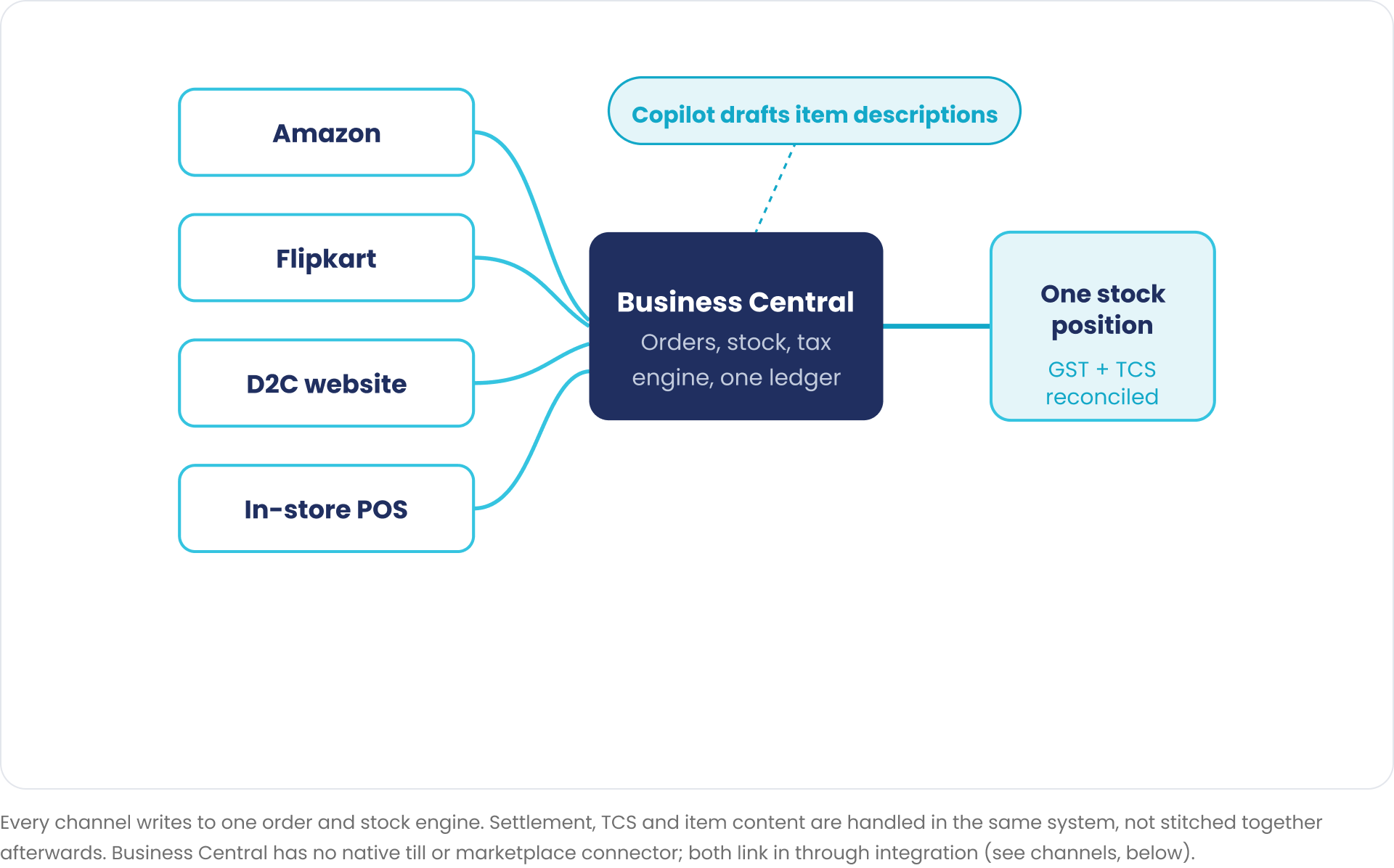
One order and stock engine behind every channel

Amazon, Flipkart, a D2C site and a physical till each speak their own format. They all write to the same Business Central, so stock, settlement and content are handled once, not four times.

Channel by channel

How each channel actually connects to Business Central

Four channels, four different integration shapes. Pick one to see what it involves.

Amazon and Flipkart marketplaces

Orders, stock feeds, pricing and the settlement file each arrive in the marketplace’s own format, on its own cycle. They are landed and normalised into Business Central rather than worked from a portal export, so an order looks the same whether it came from Amazon, Flipkart or your own website.

Orders and stock feeds synced without manual re-entrySettlement files ingested and matched to orders automaticallyPricing and content changes pushed from one item record

D2C website

A direct-to-consumer storefront writes orders straight into Business Central rather than a disconnected shopping cart database, so stock shown online is the stock the warehouse is actually holding, updated as orders happen rather than on a nightly sync.

Real-time stock so the website never oversellsPayment gateway settlement reconciled the same way as marketplacesCustomer record shared with support and with in-store, if you have it

In-store point of sale

Business Central has no native till. A dedicated retail or POS product sits at the counter and integrates back, posting sales, cash and store-level stock into the same ledger every other channel uses, so a store manager and a marketplace manager are looking at one number.

Store sales and cash posted into the same ledger as onlineStore-level stock counted against the same item masterIntegrated rather than bolted on, with the support model stated up front

Quick commerce and dark stores

Ten- and twenty-minute delivery platforms run on their own inventory and order APIs, with stricter stock-freshness requirements than a standard marketplace. Where you run dark stores or a quick-commerce listing, the same settlement and stock-allocation logic applies, tuned to a much shorter cycle.

High-frequency stock sync tuned to a short delivery windowSettlement reconciled on the platform’s own, often daily, cycleAllocation rules that protect dark-store stock from other channels

Settlement reconciliation

From a net remittance back to what you actually earned

This is a data and integration exercise more than an ERP feature, which is exactly why it is usually left undone. It is also the single highest-value thing an Indian online retailer can automate.

1We set it up

Ingest the settlement file

Each marketplace publishes its own format on its own cycle. They are landed and normalised rather than opened in Excel.

2We set it up

Match to order

Every line matched back to the order and the item it relates to, including the ones that do not match, which are the interesting ones.

3We set it up

Post by component, incl. TCS

Commission, logistics, penalties, returns and TCS each posted to their own account rather than netted into revenue.

4Built in

Report true margin

Margin by SKU and by channel after every deduction, which is frequently the first time anyone has seen it.

We set it up

the settlement integration, built once per marketplace

Built in

reporting, once the postings are correct

Honest assessment

There is no till in the box

Business Central has no native point of sale. If you run physical stores you need a dedicated retail or POS product on top, integrated rather than bolted on, and that changes the cost, the integration surface and the support model.

Recommended

ERP alone works

Marketplace and D2C onlyNo physical retail counterFulfilment from own or 3PL warehouses

Choose this when settlement reconciliation is the priority and there is no till to integrate. Adding a POS here is an expense with no return.

You need a POS as well

Physical stores taking paymentStore-level stock and cash reconciliationLoyalty at the counter, offline-tolerant billing

Choose this when stores take payment at a counter. Establishing which you are is one of the first questions in discovery, so you are never quoted for both.

Where to go next

The three pages an online retailer usually reads after this one

Business Central for India

The localisation position: GST, e-invoicing, TDS and TCS explained in plain language. Plus licence prices in rupees.

Marketplace and payment integrations

How a settlement file, a payment gateway or a courier API gets connected, tested and kept working after a marketplace changes its format.

In-store apps

Stock counts, goods-in and price checks on a phone, writing back to the ERP without a POS licence for every device.

Lead magnet

Get a GST readiness check

We review your registrations, returns and e-invoicing set-up against Business Central, and send you the findings in writing.

Common questions

What Indian retailers ask

Have a question that is not covered here? Send it to a consultant and you will get a reply within one working day. The full list is on our FAQs page.

Can it reconcile marketplace settlements?

That is the point of doing this properly. A marketplace remits a net figure after commission, logistics, penalties, returns and TCS. Reconciling that back to order level, and posting each component to the right account, is the difference between knowing your margin and estimating it. It is a data and integration exercise more than an ERP feature, which is why it is usually left undone.

Marketplaces collect TCS on the supplies they facilitate, and the credit has to be claimed and reconciled against your own records. What the ERP owes you is a position you can defend: what was collected, against which supplies, and what remains unreconciled. Configuring that correctly is part of the implementation rather than a later fix.

Business Central has no native till. If you run physical stores, you need a dedicated retail or POS product on top, integrated rather than bolted on, and that changes the cost and the support model. If you are D2C and marketplace only, you do not, and establishing which you are happens early in discovery.

Yes, and it is usually the second most valuable thing after settlement reconciliation. The hard parts are allocation, so one channel cannot oversell another channel’s stock, and returns, because a return touches stock, the ledger and the customer record at once and getting the sequence wrong shows up in the accounts.

Yes. Copilot in Business Central can draft item descriptions and marketing copy from existing attributes, useful when you are listing hundreds of SKUs across marketplaces that each want their own tone and length. A person still reviews and publishes; Copilot removes the blank-page problem, not the judgement.

Client outcomes

Client outcomes delivered by Alphavima

Selected stories from Alphavima’s global client base in North America and the UK, delivered on the same Microsoft platforms we implement for businesses in India.

01 / 02

Retail · Canada

One customer view joined across online and in-store data

A single customer view with embedded Power BI

Walmart Labs Canada

Power BI EmbeddedGoogle Cloud Platform

Wholesale distribution · USA

99%+ inventory accuracy after barcode warehouse management

Barcode warehouse management for a national distributor

Confidential client

Business CentralWarehouse ManagementEDIPower BI

Next step

Turn a settlement file into a margin you trust

Marketplaces, order volume, return rate and how long your reconciliation currently takes to close.