



Home/Industries/Distribution and Supply Chain
Distribution and supply chain
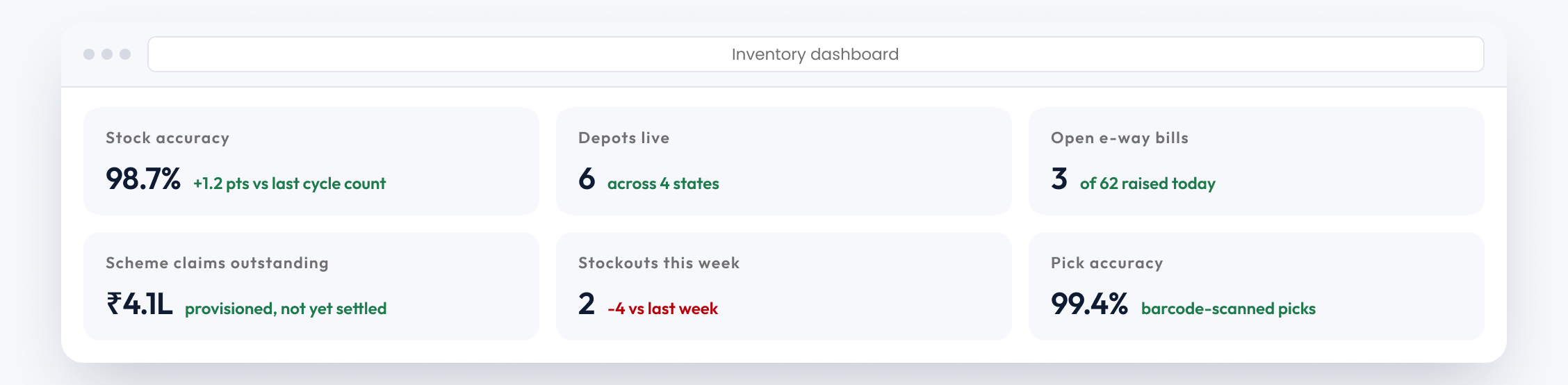
Stock in six depots across four states, each with its own GSTIN. Goods moving on e-way bills. Schemes and claims that nobody can reconcile until the quarter closes. That is the distribution problem, and it is a statutory problem as much as a logistics one.
Multi-state, multi-GSTIN stock and branch transfers with e-way bill handling
Scheme, discount and claim structures that reconcile rather than accumulate
Secondary sales and distributor visibility without re-keying
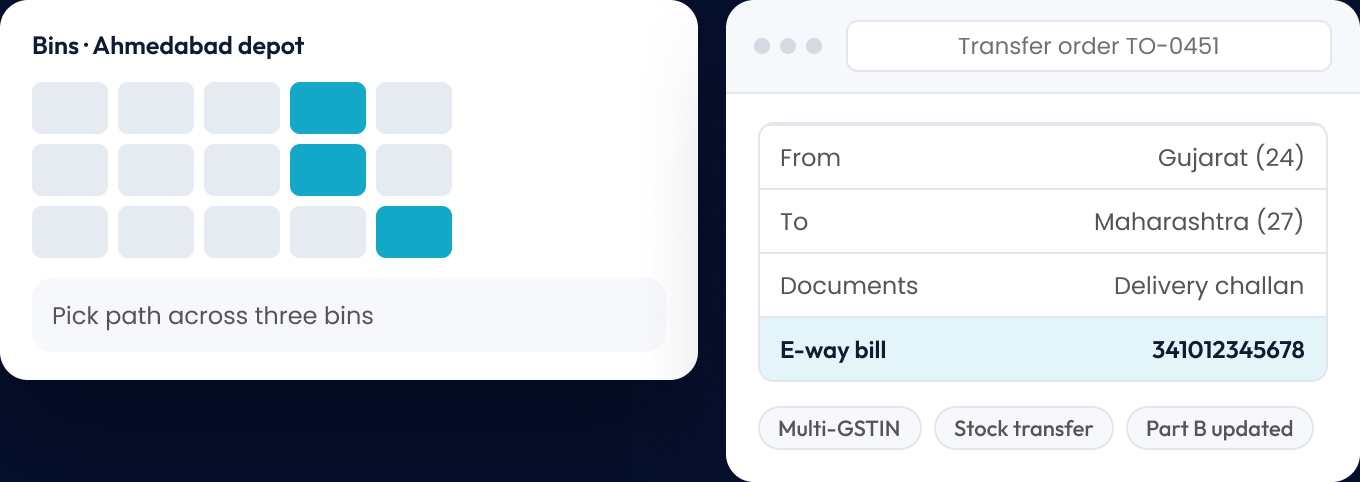
Illustration with sample data
Microsoft Solutions Partner for AI Business Solutions (formerly Business Applications) and Modern Work. ISO 27001 and ISO 9001:2015 certified.
years in business
Microsoft-certified consultants
clients globally
client satisfaction
That single fact reshapes distribution ERP software more than any feature list. Six depots across four states means four GST registrations, four sets of returns, and a document plus an e-way bill every time stock moves between two places you own.
Most distribution ERP pages describe warehouse management. Warehouse management is the part most distributors were already handling adequately with a spreadsheet and experienced staff. What they cannot do on a spreadsheet is reconcile four GSTINs, provision for schemes that have not been claimed yet, and produce a stock position they would defend to an auditor.
What actually hurts
Branch transfers as supplies. Documentation, valuation and e-way bills on every inter-state movement of your own stock.
Schemes and claims accruing invisibly. Volume slabs and period schemes that nobody can quantify until the quarter closes.
E-way bills at volume. Manual and tolerable at low volume; a business-stopping dependency at real volume.
Secondary sales invisibility. You know what you shipped to the distributor. You do not know what they sold.
Stock that never quite ties. Across depots, in transit, and with the difference argued about rather than explained.
Six steps, scanned rather than written down. The tag on each shows what Business Central does on its own and where Alphavima configures the statutory layer around it.
1Built in
Received against a purchase order, checked if required, and put into stock with full traceability.
2Built in
Barcode-scanned directed put-away assigns a bin automatically, so the system knows where stock is, not just how much.
3We set it up
A movement between two of your own depots is a supply. It raises a transfer order, a document and an e-way bill through the GSP.
4Built in
Barcode-scanned picking against the sales order, with shortages and substitutions flagged before dispatch, not after.
5We set it up
Delivery note and invoice raise the outbound e-way bill automatically once the load is confirmed.
6Built in
CGST, SGST or IGST worked out from place of supply, posted to the right GSTIN, ready for the return.
Business Central, out of the box
configured against your GSTINs and your GSP
Registration modellingBranch transfersIntercompanyConsolidated close
Whether depots model as separate companies, as locations with dimensions, or as a combination is the single largest design decision in a distribution implementation, and it has statutory consequences that reach every transfer, every return and every close.
Integration through a GSP at volume, with cancellation and vehicle-change handling designed rather than discovered mid-dispatch. A loading bay that stops because an integration failed silently at 6pm is a business problem, not an IT one, and it is designed for up front.
GSP integrationCancellationVehicle changeFailure alerting
Slab and period schemesClaim provisioningCredit notesReconciliation
Volume slabs, period schemes, secondary claims and credit notes accrue a liability. The requirement is usually less about calculating them and more about provisioning and reconciling them before the quarter closes, which is a design conversation with finance rather than a feature checkbox.
Bins, directed put-away and pick, transfers in transit, and a costing method applied consistently rather than argued about at close. The figure a salesperson quotes against is the figure the depot is actually holding.
Multi-locationIn-transitCostingCycle counts
Illustrative sample data, not a client screenshot.
Business Central handles bins, directed put-away and pick natively, with barcode scanning covering receiving, put-away, picking and cycle counts. For most Indian distributors that is genuinely sufficient.
Recommended
Depot and branch operations
Barcode-scanner picking
Moderate line volumes
Choose this when stock accuracy is the goal, not throughput, and Business Central’s own barcode module already covers your warehouse.
Conveyor or sortation automation
Voice or wearable picking
Very high lines per hour
Choose this when labour management is a discipline in its own right and the ERP needs a dedicated warehouse system alongside it, kept in agreement with it.
Establishing which side of that line you are on is one of the first things discovery settles, so you are quoted for the warehouse you actually run rather than the bigger option.
The localisation position: GST, e-invoicing, TDS and TCS explained in plain language. Plus licence prices in rupees.
What happens to years of stock and ledger history, and why the cutover aligns to a period boundary rather than a convenient weekend.
Scanning, cycle counts and driver acknowledgement on a phone, writing back to the ERP without a warehouse-system licence.
We review your registrations, returns and e-invoicing set-up against Business Central, and send you the findings in writing.
Have a question that is not covered here? Send it to a consultant and you will get a reply within one working day. The full list is on our FAQs page.
Each registration is a separate GSTIN with its own returns, and a movement between two of your own locations in different states is a supply that generates a document and an e-way bill, not an internal transfer you can ignore. Modelling that correctly, and deciding whether locations are companies or dimensions, is the single largest design decision in a distribution implementation and it has to be made before configuration.
Yes, and this is where distribution implementations most often go wrong. Volume slabs, period schemes, secondary claims and credit notes accrue liabilities that have to be visible before the quarter closes rather than discovered in it. The requirement is usually less about calculating them and more about provisioning and reconciling them, which is a design conversation with your finance team rather than a feature checkbox.
At low volume this is manual and tolerable. At real volume it needs an integration, which in practice means a GSP or equivalent, and the design questions are what happens on failure, on cancellation and on a vehicle change. A distributor whose dispatch stops because an integration failed silently at 6pm has a business problem, not an IT one.
Yes. Business Central’s warehouse module supports barcode-driven receiving, put-away, picking and cycle counts out of the box, which covers most Indian distribution operations without an extra licence. Where you need voice picking, conveyor integration or very high throughput, a dedicated warehouse system alongside the ERP becomes the right answer.
Business Central handles bins, directed put-away and pick natively, and for most Indian distributors that is sufficient. Above a certain throughput, or with real automation, a dedicated warehouse system alongside it becomes the right answer and the two then have to agree. Establishing which side of that line you are on is one of the first things discovery settles.
Selected stories from Alphavima’s global client base in North America and the UK, delivered on the same Microsoft platforms we implement for businesses in India.
01 / 03
Wholesale distribution · USA
99%+ inventory accuracy after barcode warehouse management
Confidential client
Business CentralWarehouse ManagementEDIPower BI
Equipment and fleet distribution · USA
Reporting cycle from 15 days to live, with 3 ERPs in one warehouse
Custom Truck One Source
Power BIAzure Data LakeAzure Data Factory
Equipment and fleet distribution · USA
Zero downtime during a full ERP migration, with 100% data integrity validated
Custom Truck One Source
ETL pipelinesData validation and reconciliation
Depot count, GSTIN count, scheme complexity, and what your barcode warehouse setup looks like today.
Online · replies instantly
Talk to our team
This chat is powered by AI. Conversations may be stored to improve our service. Please do not share sensitive personal information.