


 Dynamics 365Customer Engagement

Home/Insights
Insights
Writing that answers a question
Practical notes on Dynamics 365, Business Central and Indian statutory compliance. Written to be useful to somebody mid-decision, not to fill a content calendar.

Microsoft Solutions Partner for AI Business Solutions (formerly Business Applications) and Modern Work. ISO 27001 and ISO 9001:2015 certified.
20+
years in business
100+
Microsoft-certified consultants
100+
clients globally
97%
client satisfaction
What goes here
Three kinds of article, written by the people who do the work
A deliberately narrow remit. Anything that does not fit one of these three does not get written, and every article is drafted by a Microsoft-certified consultant who has actually done the work it describes, not by a content team working from a keyword list.
Example topics
E-invoice IRN and signed QRTDS section 194Q, in practiceMulti-GSTIN number series
01
Statutory explainers
What a rule actually requires, what Business Central does about it out of the box, and what still sits with your chartered accountant. Written to be printed and handed to your CA, not to rank for a keyword.
- Links into the Business Central localisation matrix
- Updated when a government notification changes a threshold
02
Decision guides
Tally against Business Central, Business Central against Finance and Supply Chain Management, when to move and when staying put is the better call. Fair comparisons rather than a case for switching regardless of fit.
- Links into the product comparison
Example topics
Tally vs Business Central, by triggerBusiness Central vs Finance and SCMWhen to stay on your current system
Example topics
Cutover on a GST period boundaryWhat a release upgrade actually breaksReconciling opening balances
03
Delivery notes
What actually happens in a migration, a cutover or a release upgrade, written from delivery rather than from marketing, including the parts that go wrong when they are rushed.
- Links into migration and upgrade
What we are writing next
The questions Indian finance and operations teams keep asking
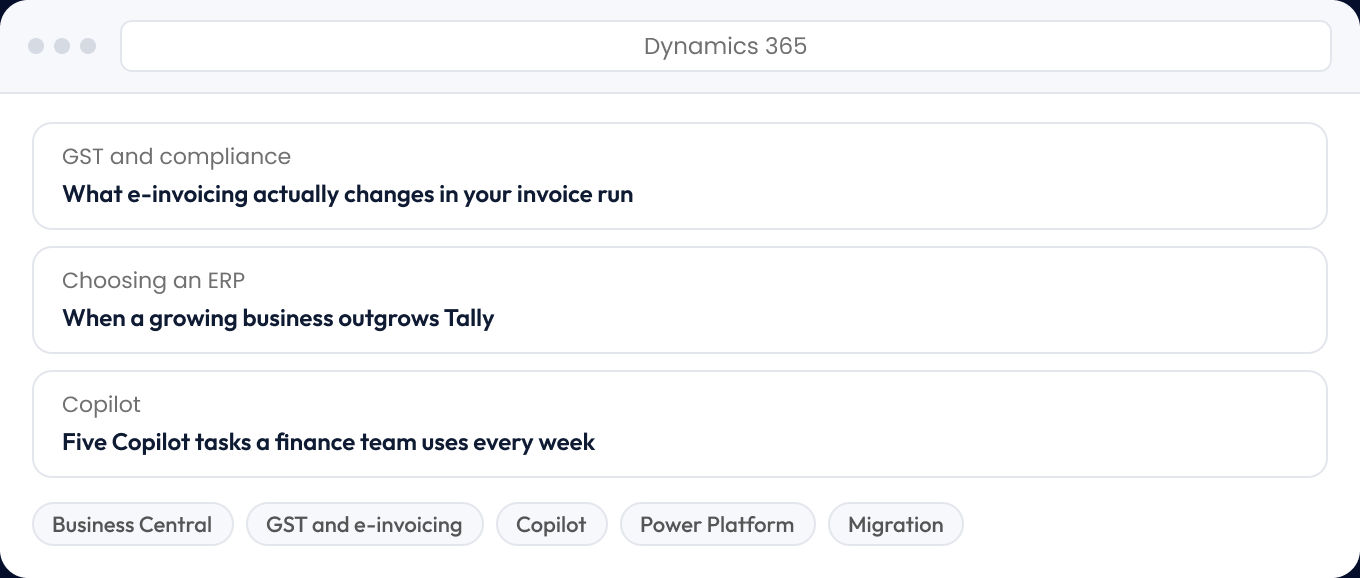
GST and e-invoicing in Business Central
How the e-invoice JSON, IRN and signed QR actually flow between Business Central, your GSP and the Invoice Registration Portal, what breaks when a credit note is cancelled after the IRN is generated, and how to keep multi-GSTIN number series clean across states.
Input tax credit that will not reconcile
Why purchase registers and GSTR-2B disagree, the four mismatch types worth chasing before a filing date, and where to automate matching once volumes justify it.
Moving off Tally without losing history
What to migrate and what to archive, how to handle opening balances and open documents, and why a parallel run of one full month is worth the effort it costs.
Copilot in day-to-day finance work
Where Copilot genuinely saves time in Business Central, what it needs from your data first, and the checks to keep in place before anybody acts on a suggestion.
Licence cost, honestly counted
Essentials against Premium, where Team Members is the right licence, and the running costs people forget: storage, environments, GSP charges and the twice-yearly release work.
Life after go-live
What changes in the first quarter on a new ERP, how statutory changes get absorbed, and what a support arrangement should cover before you sign it.
Each article is written by a consultant who has delivered the work, reviewed against current Microsoft documentation, and dated so you can tell how fresh it is. We publish when we have something useful to say rather than to a calendar, and we correct pages when the rules change, which in India they do.
Start here
Three pages worth reading before the first article lands
Until the archive fills up, these three cover most of what an article would tell you.
Business Central vs Tally, Zoho and Odoo
A fair, line-by-line comparison against the systems most Indian SMEs are actually running today.
Business Central for India
The GST, TDS and e-invoicing localisation matrix, and what Business Central does out of the box.
Case studies
Fifteen published client outcomes across 13 industries, with the metrics that were actually measured.
Next step
Have a question we have not written about?
Ask it directly. It is usually faster than waiting for an article, and it tells us what to write next.