



Home/Industries/Manufacturing
Manufacturing
Job work challans that have to reconcile against ITC-04. Material moving between plants on an e-way bill. A costing method that survives an audit. Those are the manufacturing problems Indian ERP has to solve, and they are the ones generic vertical pages never mention.
Job work: challans out, receipts back, and the ITC-04 position that follows
Multi-plant and multi-GSTIN stock transfers with e-way bill handling
BOM, routing and costing that reconciles to the ledger rather than sitting beside it
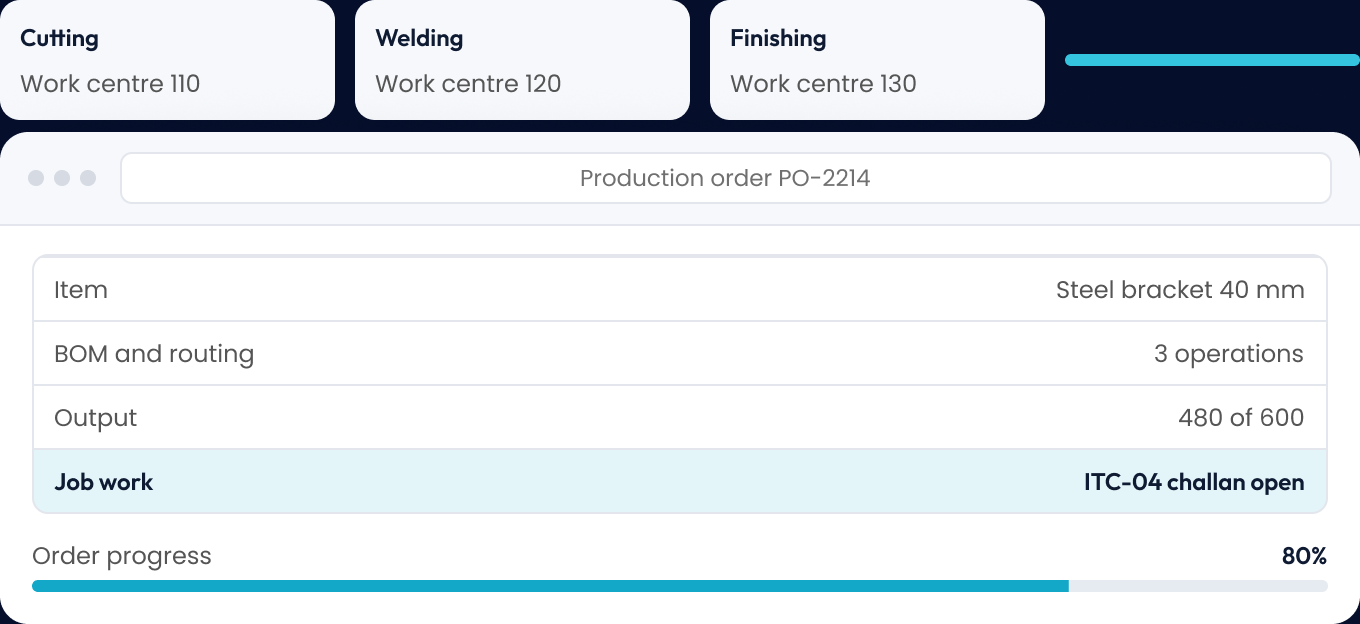
Illustration with sample data
Microsoft Solutions Partner for AI Business Solutions (formerly Business Applications) and Modern Work. ISO 27001 and ISO 9001:2015 certified.
years in business
Microsoft-certified consultants
clients globally
client satisfaction
Ask what manufacturing ERP software actually has to do for an Indian plant, and the real answer is rarely “real-time visibility”. It is that the stock lying with three job workers has to reconcile, the transfer between plants has to move on a valid e-way bill, and the costing has to survive a question from an auditor.
Those are statutory positions your ERP either holds correctly or does not, and the cost of it not holding them correctly does not appear in a dashboard. It appears in a notice.
Most manufacturing ERP pages, including those of far larger firms than us, describe production planning and stop there. Production planning is the part most manufacturers were already managing adequately. What comes next on this page is the part that is not.
What actually hurts
Job work reconciliation. What went out on a challan, what came back, what is still lying outside, and whether that agrees with the return.
Stock transfers between plants. Two locations, two states, two GSTINs. That is a supply with a document and an e-way bill, not an internal move.
Costing that nobody can defend. A standard cost set three years ago, variances nobody analyses, and a gross margin finance does not fully believe.
Shop floor data arriving late. Production booked at the end of the week from a register, so the stock position is always a few days behind reality.
Scrap, rework and by-product. Handled informally, invisible in costing, and material enough to matter.
Seven steps. The tag on each shows what Business Central does on its own and where Alphavima configures the statutory layer around it.
1Built in
Confirmed against credit, promise date and available stock before production is triggered.
2Built in
Demand netted against stock and open supply to raise a production or purchase suggestion.
3Built in
Released against a BOM and routing, consuming components and booking capacity as the work happens.
4We set it up
Material issued to a subcontractor on a challan, tracked while outstanding, and reconciled into the ITC-04 position.
5Built in
Inspection at receipt or output, with lot and serial tracking carried through to dispatch and to recall if it is ever needed.
6We set it up
Delivery and invoice raise the e-way bill through the GSP connection once the shipment is confirmed.
7Built in
Standard or actual cost flows back to the general ledger, with variance visible by order rather than buried at close.
Business Central, out of the box
configured against your GSTINs and your GSP
Challan issue and receiptOutstanding position by job workerITC-04 dataScrap and shortage
Material issued against a challan, tracked while it sits with the job worker, received back with quantity and scrap accounted, and reconcilable at any date. The ERP owes you a defensible position on what is outstanding; the filing obligation stays yours.
Whether your plants model as separate companies, as locations with dimensions, or as a combination, is a design decision with statutory consequences. It shapes your transfers, your e-way bill handling, your intercompany treatment and your close.
Branch transfersMulti-GSTINE-way billsIntercompany
Multi-level BOMRoutings and capacityStandard and actual costVariance analysis
Bills of material and routings that reflect what the plant actually does, with costing applied consistently rather than argued about at close. Variance you can explain rather than a number that appears and is written off.
Production confirmation, quality checks and downtime captured where the work happens, on a tablet or a phone, writing back to the ERP. Built on Power Platform so it does not need a full ERP licence for every operator and does not need an ERP release to change.
Power AppsNo full licence per operatorOffline tolerantQuality and downtime
Discrete, make-to-order and assembly manufacturers run on Business Central as it stands. Process manufacturers get there with a specialist add-on, and multi-site or highly regulated operations graduate to Dynamics 365 Supply Chain Management. Four dots means the capability is native to Business Central for every type covered here, discrete through process. Fewer dots means part of it depends on a specialist AppSource add-on or, at genuine multi-site scale, on Dynamics 365 Supply Chain Management.
BOM, routings and capacity
Native for discrete, make-to-order, assembly and multi-site; the process add-on extends the same concept to formula and batch
MRP and material planning
Demand netted against stock and open supply across every manufacturing type, including process with the add-on
Job work and subcontracting
Native for discrete, make-to-order, assembly and multi-site; for process manufacturers it depends on the add-on chosen in discovery
Lot and serial traceability
Native everywhere; process manufacturers get it through the add-on, which is also where batch and potency tracking lives
Formulation, batch potency and yield
Not a discrete manufacturing requirement; process manufacturers get it through BatchMaster or Aptean, evaluated against your process in discovery
Co-product and by-product costing
Partial for assembly; full for process manufacturing with the add-on and native in Dynamics 365 Supply Chain Management
Consolidated multi-plant planning
Partial across single-site manufacturing types; native once you are on Dynamics 365 Supply Chain Management for real multi-site planning
Business Central’s manufacturing module is built for discrete production: countable components, bills of material and routings. That covers engineering, fabrication, assembly and make-to-order work well on its own.
Formula- and batch-driven process manufacturing, typical of food and beverage, pharmaceuticals and chemicals, extends the same Microsoft ecosystem with specialist AppSource add-ons such as BatchMaster or Aptean. They bring formulation, batch and lot potency, and quality workflows into Business Central rather than a separate system, and we evaluate which one fits your process in discovery.
For multi-site or highly regulated process operations, Dynamics 365 Supply Chain Management is the natural upgrade path within the same Microsoft family, for when the complexity is in the operation rather than the company’s size.
Engineering and fabricationAuto components and assembliesElectricals and electronicsPlastics and moulding, discretePackaging and printing
Food and beverage processingPharmaceuticals with batch potencyChemicals and specialty formulationsPaints, inks and coatingsMulti-site or regulated: Dynamics 365 SCM
Add-ons evaluated against your process in discovery; no formal reseller partnership is claimed with either vendor.
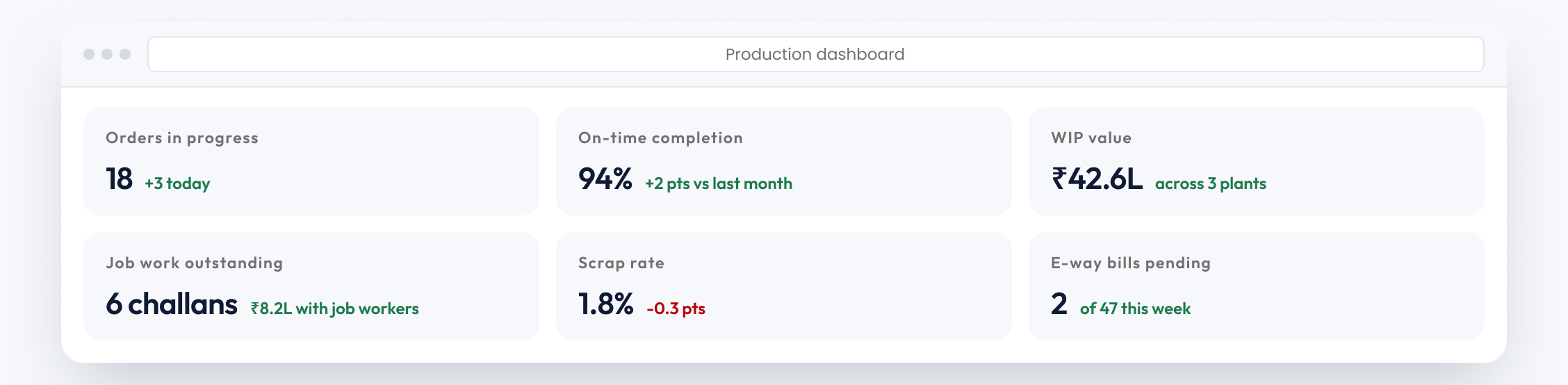
Illustrative sample data, not a client screenshot.
The localisation position: GST, e-invoicing, TDS and TCS explained in plain language. Plus licence prices in rupees.
What happens to twelve years of data, how much history should move, and why the cutover aligns to a period boundary.
Production confirmation and quality capture without a full ERP licence per operator, and without an ERP release to change it.
We review your registrations, returns and e-invoicing set-up against Business Central, and send you the findings in writing.
Have a question that is not covered here? Send it to a consultant and you will get a reply within one working day. The full list is on our FAQs page.
The material movement, the challan, the receipt back and the reconciliation of what is lying with a job worker are all modellable, and this is one of the areas where configuration quality decides whether the system is useful or merely present. The statutory return that follows is your filing obligation, and what the ERP owes you is a defensible position on what went out, what came back and what is still outstanding, at any date. That is what we build for.
Business Central’s core manufacturing is discrete: countable components, bills of material and routings, which covers assembly and make-to-order work well. Formula- and batch-driven process manufacturing, typical of food, pharma and chemicals, extends the same Microsoft ecosystem with specialist AppSource add-ons such as BatchMaster or Aptean, covering formulation, batch and lot potency, and quality workflows. We evaluate the fit against your process in discovery. For multi-site or highly regulated process operations, Dynamics 365 Supply Chain Management is the natural upgrade path within the same Microsoft family.
It is a design decision with statutory consequences, which is why it belongs in discovery. Each GST registration is a separate GSTIN with its own returns, and whether plants model as separate companies, as locations with dimensions, or as a combination changes your stock transfers, your e-way bill handling, your intercompany treatment and your close. Getting it wrong is expensive to unwind.
Yes, and it usually should not be an ERP licence per operator. Power Apps on a tablet or a phone for production confirmation, quality checks and downtime capture, writing back to the ERP, is cheaper to build, far cheaper to change, and does not need everyone on the plant floor to hold a full user licence.
A process-manufacturing add-on such as BatchMaster or Aptean sits inside Business Central and is the right scale for a single site with formulation, batch or potency requirements. Once you are running several plants, high transaction volume, or advanced regulatory workflows, Dynamics 365 Supply Chain Management carries that natively and becomes the more direct fit. It is a question of scale and complexity, and it belongs in discovery rather than a brochure.
Selected stories from Alphavima’s global client base in North America and the UK, delivered on the same Microsoft platforms we implement for businesses in India.
01 / 03
Discrete manufacturing
Production planning cycle cut from weeks to days
Confidential client
Business CentralPower AppsPower BI
Food and beverage
11-minute mock recall, down from four days
Confidential client
Business CentralLot traceabilityPower BI
Construction
Committed and actual job costs visible every day, not at closeout
Confidential client
Business CentralField ServicePower Apps
Plant count, states, job work volume and where your production sits on the discrete-to-process line. A focused conversation before any proposal.
Online · replies instantly
Talk to our team
This chat is powered by AI. Conversations may be stored to improve our service. Please do not share sensitive personal information.