

 Dynamics 365Customer Engagement

Home/Services/IT Advisory
IT advisory
IT advisory services in India
Roadmap, licensing position, architecture review and a second opinion on a decision already in motion. Often the most useful thing we do, and the least billable.
 Microsoft licensing position, modelled in rupees against actual usageArchitecture and integration review before a commitment is madeA written second opinion on a proposal somebody else wrote
ImplementationMigration and UpgradeSupportConsultingIntegrationIT Advisory

Microsoft Solutions Partner for AI Business Solutions (formerly Business Applications) and Modern Work. ISO 27001 and ISO 9001:2015 certified.
20+
years in business
100+
Microsoft-certified consultants
100+
clients globally
97%
client satisfaction
What this is
Advice with nothing attached to it
An advisory engagement that only ever concludes buy the thing the adviser sells is not advice. This is a separate engagement with a written output you keep, and no expectation that an implementation follows.
Sometimes the conclusion is to work with us. Often it is not: to stay with your current partner, to keep the system you have, to fix a process rather than buy software, or to go to a firm shaped differently from ours.
It is the least billable thing we do and frequently the most useful, because a written, reasoned position changes what happens in the next board meeting whether or not any of it becomes a project.
Most advisory conversations in India start from one of three places: a licensing bill that keeps growing without an obvious cause, a proposal on the table from another partner that somebody wants checked, or a roadmap question with no current deadline attached to it. All three are covered below.
What you actually receive
Not a deck of options with no recommendation, which is the standard output of this category and the reason it has the reputation it has.
A written document with a position and the reasoning behind itThe specific questions you should ask next, and of whomWhere relevant, a licence model in rupees against your real usageA clear statement of what we do not know and could not establish
Three things people ask for
What advisory actually gets used for
These are not three tiers or three price points. They are three different questions, and most engagements are really one of them wearing the others as context.
Recurring patterns
Full ERP users who only read and approvePremium licences on people who never touch productionPower Platform per-user plans where per-app would cost lessCapability bought twice across Microsoft 365 and a point product
01
Microsoft licensing position
Usually where the fastest saving sits, because licensing tends to drift quietly rather than break visibly. The recurring patterns are listed beside this paragraph, and every one of them is common enough that finding at least one is closer to normal than exceptional. Modelled in rupees against your actual usage, not against a vendor’s published list.
02
Architecture and roadmap review
What you have, what it costs to keep, and what genuinely has to change in the next two years against what merely could. This is the engagement behind the maturity ladder and the roadmap horizons below: it produces the actual document, and those two components are how we structure the thinking that goes into it.
03
Second opinion on a proposal
What is scoped and what is assumed about your data. What the day commitment on your side really is. Whether the timeline survives contact with a period close. And where the proposal is actually fine, which we will also say, because a second opinion that only ever finds fault is not a useful one.
Already working with another partner? A second opinion is a normal professional service and does not require you to be unhappy with anyone.
Where you are now
Four stages, and advisory means something different at each one
Most Indian mid-market IT estates sit somewhere on this ladder. Knowing where changes what an advisory engagement should actually produce.
1
Reactive
Systems are patched around problems as they appear, and no one owns a forward plan.
OutputWritten current-state assessment
2
Stable
The core ERP runs, and licensing is broadly under control, but there is no plan beyond the next release.
OutputSequenced roadmap
3
Optimised
The roadmap exists and licensing is efficient; the gap has moved to data and reporting trust.
OutputRoadmap connected to a data assessment
4
Strategic
IT decisions are made against a written architecture rather than case by case.
OutputAnnual review cadence rather than a project
Most conversations start at Reactive or Stable. Moving a rung takes a written plan and somebody accountable for it, not a purchase.
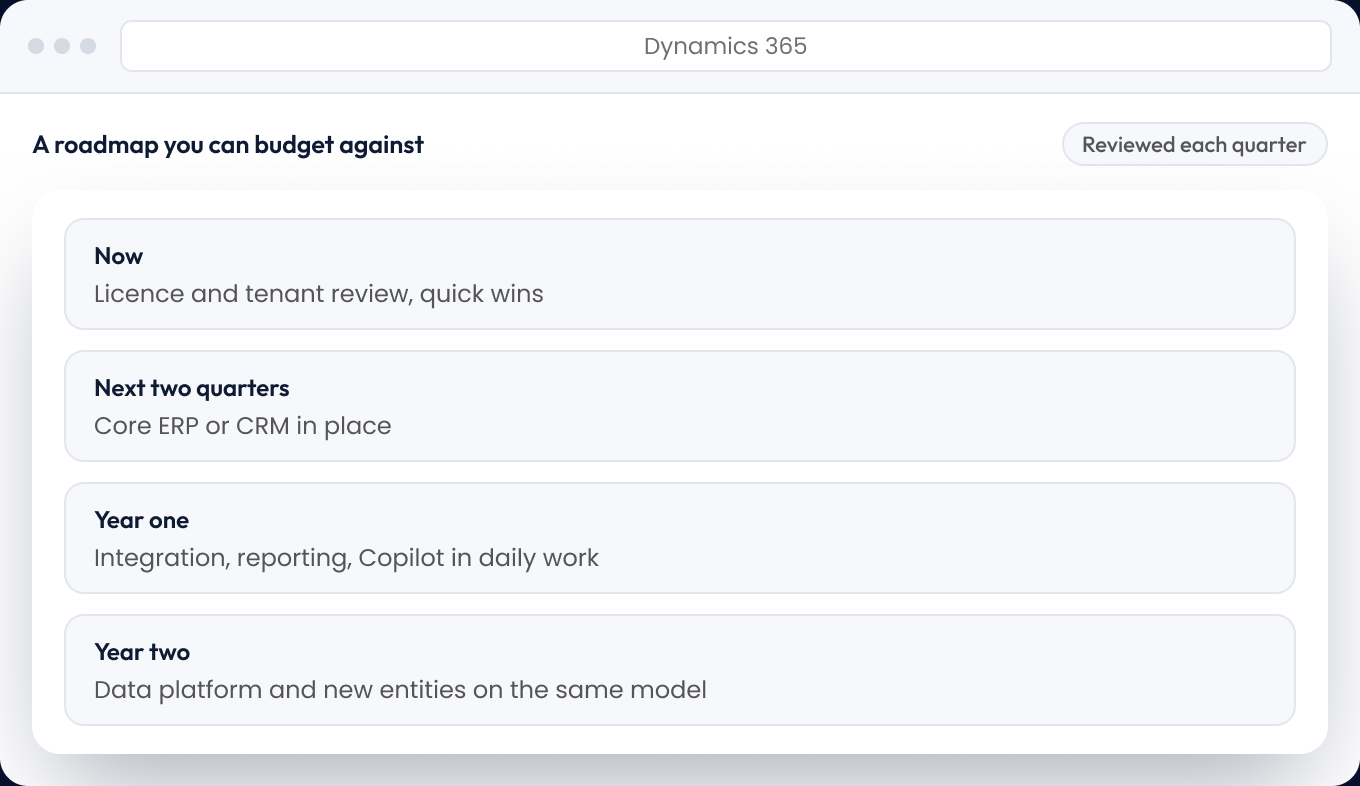
Roadmap horizons
What a roadmap covers at each distance
A roadmap that only lists everything you might eventually do is not a roadmap. Each horizon below has a different kind of decision attached to it, and a different kind of output.
0–3 months
Licensing clean-upQuick governance fixesObvious quick wins
3–12 months
Architecture decisionsIntegration sequencingA support model review
12–24 months
Microsoft FabricCopilotFurther Dynamics 365 modules
The near horizon produces written recommendations, several actionable without new spend. The middle horizon produces a costed roadmap you can put in front of your board. The far horizon produces a defined revisit point, not a pre-sold next project.
Boundaries
What advisory does not replace
Being clear about what this engagement is not for saves everyone time, and it is part of why the written output stays useful rather than becoming a sales document in disguise.
It is not a substitute for implementation
Advisory produces a decision and a written plan. It does not configure a chart of accounts, migrate a ledger, or connect a GSP. When the recommendation is to move ahead, that becomes a separate, separately scoped implementation or migration engagement, priced on its own terms.
It is not a compliance audit
A licensing or architecture review looks at whether your Microsoft estate is efficient and coherent. It is not a statutory audit of your GST, TDS or accounting position, and it does not substitute for your chartered accountant's sign-off on a return. Where the two overlap, we say so and point you to the right professional rather than stretching the engagement to cover it.
It is not a vendor certification or an endorsement
A written second opinion is our read of a proposal, not a certification that binds anyone else, and it carries no warranty over the partner who wrote the original document. It is useful precisely because it is independent, and independence means it does not become a guarantee.
It is not a free scoping exercise for a future project
The engagement is priced and delivered on its own terms, with its own written output, whether or not a project follows. We will not stretch an advisory conversation to informally scope an implementation for free, because that is exactly the vagueness the commercial model on our services page is written to avoid.
It is not a one-off event if your estate is genuinely strategic
At the Strategic rung of the maturity ladder above, advisory works better as an annual cadence than a single engagement, because the Microsoft roadmap, your licensing position and your own business all keep moving. A single review has a shelf life measured in months, not years.
Lead magnet
Get a roadmap review
We look at your Microsoft estate, licences and plans for the year and come back with a roadmap you can budget against.
Common questions
What people ask about advisory
Have a question that is not covered here? Send it to a consultant and you will get a reply within one working day. The full list is on our FAQs page.
Is this a route into selling us an implementation?
It is a route into you having a better decision. Sometimes that decision is to work with us and often it is not. The output is written and you keep it either way. An advisory engagement that only ever concludes buy the thing the adviser sells is not advice.
Can you review our Microsoft licensing?
Yes, and it is usually where the fastest saving sits. The common patterns are full ERP users who only read and approve, Premium licences on people who never touch manufacturing, Power Platform per-user plans where per-app would cost a fraction, and duplicate capability bought twice across Microsoft 365 and a point product. We model it in rupees against your actual usage.
We already have a partner. Is this appropriate?
Yes, and we are careful about it. A second opinion on an architecture or a proposal is a normal professional service and it does not require you to be unhappy with anyone. We will not use the engagement to solicit the wider relationship, and we will tell you when your existing partner has it right.
What do we actually receive?
A written document with a position, the reasoning behind it, and the specific things you should ask next. Not a slide deck of options with no recommendation, which is the standard output of this category and the reason it has a poor reputation.
Client outcomes
Client outcomes delivered by Alphavima
Selected stories from Alphavima’s global client base in North America and the UK, delivered on the same Microsoft platforms we implement for businesses in India.
01 / 03
Utilities and power · Canada
68% less regulatory reporting time and 99.98% billing accuracy
ERP modernisation and utility analytics
Oakville Enterprises Corporation
Olix365Utility analytics
Financial services · Canada
1B+ records a day consolidated into one risk platform
Risk and regulatory reporting data platform
TD Securities
Data engineeringHadoop and Spark
Professional services
Project margin visible while work is in flight, not after it closes
Live project margin for a professional services firm
Confidential client
Dynamics 365 Project OperationsPower BI
Next step
Get a written second opinion
A decision in motion, a proposal on the table, or a licensing bill that keeps growing. Thirty minutes to scope it.