



Alphavima India

Alphavima
Microsoft Solutions PartnerMicrosoft Dynamics 365Dynamics 365Customer EngagementMicrosoft Copilot

Home/Industries/Professional Services

Professional services

Professional services ERP for project-based Indian firms

Utilisation in one spreadsheet, work in progress in another, and revenue recognised on a judgement nobody can reconstruct three months later. For a services business that is not an inconvenience, it is the P&L.

Projects, time capture, utilisation and resource costing in the system of recordWork in progress and revenue recognition that survives an audit questionGST on services, place of supply and export invoicing under LUT
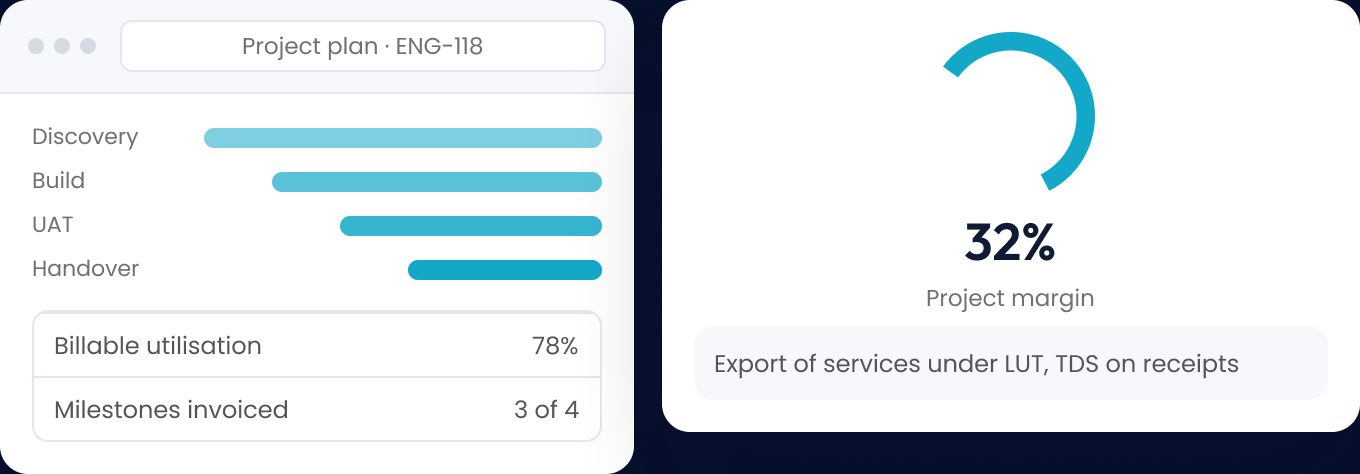

Illustration with sample data

Microsoft Solutions Partner for AI Business Solutions (formerly Business Applications) and Modern Work. ISO 27001 and ISO 9001:2015 certified.

20+

years in business

100+

Microsoft-certified consultants

100+

clients globally

97%

client satisfaction

The actual problem

For a services business, the spreadsheet is the P&L

Utilisation lives in one file, work in progress in another, and revenue is recognised on a judgement made at close that nobody can reconstruct three months later. That is the gap professional services ERP software is meant to close, and in a business whose only real cost is people, it is not an inconvenience.

The question an auditor asks is simple and frequently unanswerable: on what basis was this revenue recognised, and can you show the working? If the answer involves opening a spreadsheet and remembering what somebody decided in April, that is the problem worth fixing.

The second is utilisation. Not the number, which most firms have, but whether it reconciles to what was billed and to what sits in work in progress.

What actually hurts

The five that come up in every discovery

Revenue recognition on judgement. Applied at close rather than on a stated basis, and not reconstructable afterwards.Work in progress outside the ledger. Real value sitting in a spreadsheet, invisible until it is invoiced or written off.Utilisation that does not reconcile. To billing, to WIP, or to the resourcing plan it was supposed to follow.Export invoicing under LUT. Correct documentation and evidence, set up properly rather than approximately.Time capture nobody does. Because it lives somewhere people do not already work.
How a project reaches cash

From a signed contract to a receivable that reconciles

Six steps. The tag on each shows what Business Central does on its own and where Alphavima configures the recognition and statutory layer around it.

1Built in

Project setup, budget

Jobs, planning lines and a budget set against the contract before a single hour is logged.

2Built in

Time and expense capture

Logged on a Power App or through Teams, approved by the project manager, without a full ERP licence per consultant.

3Built in

Work in progress

Cost and unbilled revenue accrue in the ledger as the work happens, not estimated at month end.

4We set it up

Revenue recognition

Time and material as delivered, fixed price on a milestone or percentage-of-completion basis your auditor accepts.

5We set it up

Client invoice, GST

GST on services and place of supply applied automatically; export invoices raised under LUT without payment of tax where applicable.

6We set it up

TDS on receipt

TDS deducted by the client reconciled against Form 26AS, so the receivable position is accurate rather than assumed.

Built in

Business Central, out of the box

We set it up

configured against your policy, your LUT and your GSTINs

What we build for

Projects in the system of record, not beside it

Project accounting

Jobs and tasksBudget vs actualResource costMulti-currency

01

Project accounting

Jobs, planning lines, budgets and actuals, with costs and revenue attaching to the project rather than being allocated at month end from a spreadsheet.

02

Time capture that happens

On a Power App or through Teams, where people already are, writing back to the ERP. Avoids a full user licence per consultant and is better adopted because it does not require a second habit.

Time capture that happens

Teams and mobileNo full licenceApproval flowWeekly close

WIP and recognition

Stated basisWIP in the ledgerAudit trailAccruals

03

WIP and recognition

Time and material recognised as delivered; fixed price on a milestone or percentage-of-completion basis your auditor accepts. The basis is stated and the working reconstructable three months later, not just at the moment of close.

04

Export invoicing and TDS

Services exported from India carry specific treatment, including place of supply and invoicing under a Letter of Undertaking without payment of tax. TDS on receipts reconciles against Form 26AS rather than a running guess.

Export invoicing and TDS

Place of supplyLUT invoicingTDS reconciliationMulti-currency

What the partners see

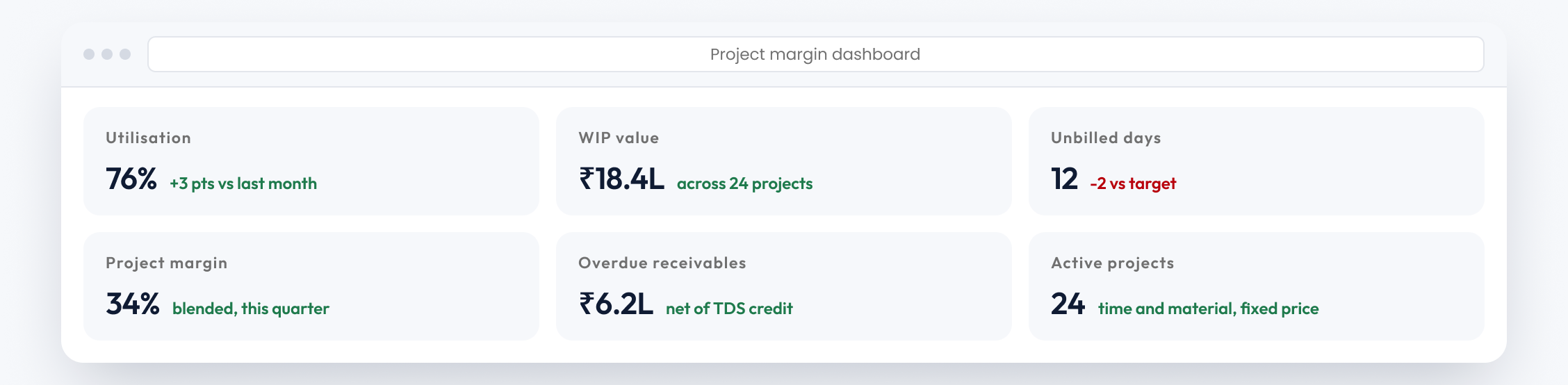
Margin visible while the project is still running

Illustrative sample data, not a client screenshot.

Honest assessment

Business Central Jobs, or Project Operations?

The distinction is about operational complexity rather than headcount. Four dots means Business Central Jobs covers the capability well on its own. Fewer dots means it is where Project Operations extends further, and it is worth discussing only if it matters to how you actually deliver.

Most Indian services firms we work with are well served by Business Central Jobs. Project Operations earns its complexity when resourcing itself, not project accounting, is the hard problem.

Time, expense and work in progress

Planning lines, time capture and WIP, native to Business Central Jobs

Resource costing against projects

Budget versus actual by project and by resource, out of the box

Straightforward delivery scheduling

Well covered for one delivery team working from one plan

Deep resource scheduling by skill and availability

Project Operations adds a full scheduling engine here

Project pipeline joined to CRM

Native in Project Operations, connected to Dynamics 365 Sales

Complex subcontracting and a full PSA layer

Where Project Operations earns its complexity over project accounting alone

Where to go next

The three pages a services firm usually reads after this one

Business Central for India

The localisation position: GST, TDS, e-invoicing and export invoicing explained in plain language. Plus licence prices in rupees.

Business Central or Project Operations?

Product selection before spend is committed, including the recommendation to stay on Business Central Jobs when that is the better fit.

Time capture on Teams

Timesheets where consultants already work, approved on mobile, without a full ERP licence per person.

Lead magnet

Get a GST readiness check

We review your registrations, returns and e-invoicing set-up against Business Central, and send you the findings in writing.

Common questions

What Indian services firms ask

Have a question that is not covered here? Send it to a consultant and you will get a reply within one working day. The full list is on our FAQs page.

Can it handle time and material and fixed price together?

Yes, and most firms run both. What matters is that each is recognised on a stated basis rather than a judgement made at close: time and material as delivered, fixed price against a milestone or a percentage-of-completion method your auditor accepts. The ERP job is to make the basis explicit and the working reconstructable.

Services exported from India have specific treatment, including place of supply rules and invoicing under a Letter of Undertaking without payment of tax where applicable. The system has to produce the right document and hold the right evidence. It is configuration rather than development, and it is the part that most often gets set up loosely and then causes an audit conversation.

Business Central handles jobs, planning lines, time capture, work in progress and resource costing, and for a great many Indian services firms that is sufficient. Project Operations is the right answer where you need deeper resource scheduling, complex project pipelines and a genuine PSA layer. The distinction is about operational complexity rather than headcount, and establishing which side you are on is one of the first things discovery settles.

Yes. Time capture on a Power App or through Teams, writing back to the ERP, avoids a full user licence per consultant and is usually better adopted anyway because it lives where people already are. Licence design for a services firm is worth doing deliberately; it is one of the larger recurring costs.

Business Central Jobs covers planning lines, time and expense capture, work in progress and invoicing well for firms with straightforward delivery. Project Operations adds resource scheduling against skills and availability, a project pipeline connected to CRM, and complex subcontracting, effectively a full PSA layer on top of project accounting. Most Indian services firms we work with are well served by Business Central; Project Operations earns its complexity when resourcing itself is the hard problem.

Client outcomes

Client outcomes delivered by Alphavima

Selected stories from Alphavima’s global client base in North America and the UK, delivered on the same Microsoft platforms we implement for businesses in India.

01 / 02

Professional services

Project margin visible while work is in flight, not after it closes

Live project margin for a professional services firm

Confidential client

Dynamics 365 Project OperationsPower BI

Insurance and warranty · USA

Three systems for sales, warranty and claims brought into one CRM

Sales, warranty and claims on one CRM

Professional Warranty Service Corporation

Dynamics 365 CRMSelf-service portals

Next step

Get utilisation and recognition out of spreadsheets

Headcount, billing model, project mix and what your month-end close actually takes today.