


Home/Services/Consulting
Consulting
Before the implementation, the decision. Which product, whether now, what it will actually cost and what has to be true internally for it to work. Including the answer that you should stay where you are for another year.
Product selection: Business Central, Finance, or staying on what you have
A business case with the numbers you will be asked for by your board
Readiness assessment: data, people and decision-making, before spend is committed
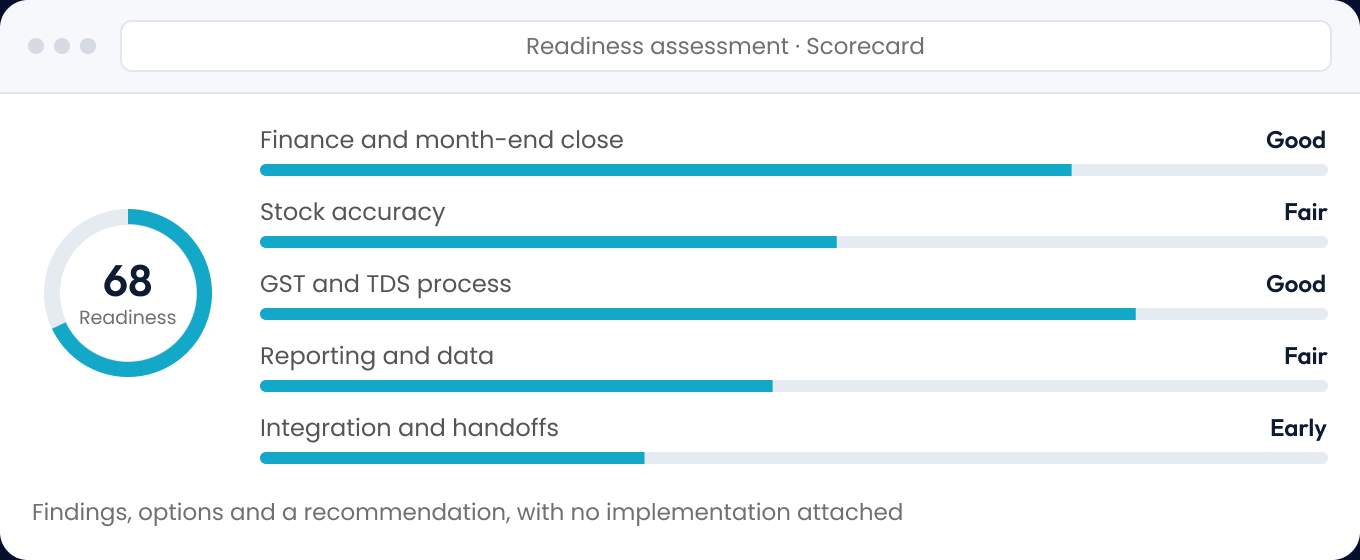
Illustration with sample data
ImplementationMigration and UpgradeSupportConsultingIntegrationIT Advisory
Microsoft Solutions Partner for AI Business Solutions (formerly Business Applications) and Modern Work. ISO 27001 and ISO 9001:2015 certified.
years in business
Microsoft-certified consultants
clients globally
client satisfaction
An implementation done well against the wrong decision is still the wrong outcome. Most of the value in an ERP programme is created or destroyed before anyone configures anything. Four questions carry it: which product, whether now, what it will genuinely cost including the internal effort nobody budgets, and what has to be true inside your organisation for it to work. We answer those as a separate engagement, with no implementation attached and no obligation to buy one.
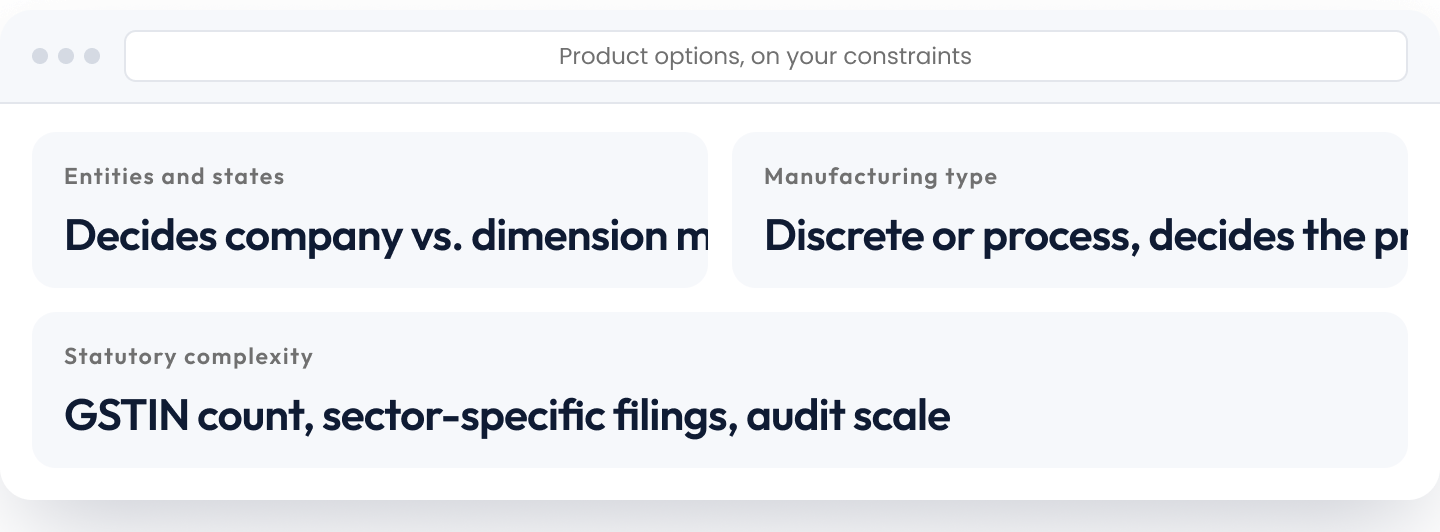
Business Central, Finance and Supply Chain, or staying where you are. The decision is worked out on entity count, manufacturing type and statutory complexity rather than a feature checklist, because those three factors are what actually change between the two products in practice.
The numbers your board will ask for, with the costs most cases omit and without a fabricated productivity percentage. It is built to survive a finance director reading it properly, which is a lower bar than it sounds and one most ERP business cases fail.
Licence, implementation and support cost, all threeInternal effort, at real costA fabricated productivity percentage
Data conditionProcess ownershipInternal capacityBudget completeness
Data condition, process ownership and internal capacity, measured before spend is committed rather than discovered once the project has started. Full detail on the four dimensions and how each one changes the plan is below.
A written read on a proposal somebody else wrote: what is scoped, what is assumed, and what is missing. This does not require you to be unhappy with your current partner. It is a normal professional check before you sign something significant.
A credible ERP business case is shorter and more boring than most. It is also the one that survives a finance director reading it properly.
What does not go in: a percentage productivity gain nobody can trace, a benefit that assumes every user adopts perfectly, or a payback period that ignores year-two support.
A consulting engagement is short by design. It produces a written position, not a slide deck of options with no recommendation.
1
What is prompting the question, and why now.
OutputAgreed scope for the engagement
2
Entity count, statutory complexity, manufacturing type, current system and data condition.
OutputFit-gap summary
3
Business Central against Finance and Supply Chain against staying put, argued on your actual constraints.
OutputShortlist with trade-offs stated
4
Costs, benefits and the readiness score below, built from what you actually have rather than a template.
OutputCosted business case
5
A written position: move, wait, or fix a process first.
OutputThe document itself, yours regardless of what happens next
A project can be technically ready and organisationally not, or the other way round. Both matter, and a business case that only counts the first is incomplete. The scale below shows how much each dimension typically decides the shape of the plan: four dots means it routinely overrides everything else, two or three means it matters but can usually be corrected once identified.
Data condition
Duplicate masters, reconciliation gaps, how far back history goes
Process ownership
Who can actually settle a chart of accounts or GSTIN-modelling question
Internal capacity
Who can give the project real days, not spare time around their job
Budget completeness
Whether licence, implementation, integration and support are all costed
Illustrative weighting, not a score for any particular company. Your own readiness assessment is produced against your own data, people and budget during the engagement.
It happens, and a consultancy that has never given this advice is not a consultancy. Here are the situations where the honest recommendation is to wait.
The pain is a process problem. If the reconciliation exists because two teams disagree about who owns a step, new software will not settle it.
Nobody internal can own it. An ERP project without a decision-maker who has real authority on your side will run long and cost more, whoever implements it.
The current system genuinely works. One entity, one state, clean data, simple stock. Tally is doing its job and leaving it is an expense without a return.
You are mid-way through something bigger. A merger, a plant commissioning, a leadership change. The project will not get the attention it needs.
The driver is one report. If what you actually want is a number you can trust, that may be a data problem rather than an ERP one, and far cheaper to solve.
Tell us your entity count, manufacturing type and current system. We come back with a short written view on Business Central, Finance and Supply Chain, or staying put.
Have a question that is not covered here? Send it to a consultant and you will get a reply within one working day. The full list is on our FAQs page.
Regularly. If your current system does the job, your data is clean, and the pain you are describing is a process problem rather than a software one, the recommendation is to fix the process and revisit in a year. That costs us a sale and it is still the right call for you.
Yes, and it is one of the more useful things we do. We look at what is scoped, what is assumed about your data, what is missing, what the day commitment on your side really is, and whether the timeline survives contact with a period close. You get a written read, with no obligation to work with us afterwards.
Licence cost, implementation cost, internal effort, and the ongoing support and release-cycle cost that most cases omit entirely. On the benefit side, the credible lines are reconciliation time removed, stock accuracy, faster close and statutory risk reduced. We will not put a fabricated productivity percentage in it.
Usually a few weeks rather than months, because the decision turns on a small number of facts: entity and state count, manufacturing type, data condition, integration list and internal capacity. Gathering those honestly is most of the work.
Selected stories from Alphavima’s global client base in North America and the UK, delivered on the same Microsoft platforms we implement for businesses in India.
01 / 03
Professional services
Project margin visible while work is in flight, not after it closes
Confidential client
Dynamics 365 Project OperationsPower BI
Insurance and warranty · USA
Three systems for sales, warranty and claims brought into one CRM
Professional Warranty Service Corporation
Dynamics 365 CRMSelf-service portals
Healthcare
Patient record lookup across departments from minutes to seconds
Confidential client
PulseNet365Dynamics 365Power Automate
Product selection, a business case, or a second opinion on somebody else proposal. Thirty minutes and an honest read.
Online · replies instantly
Talk to our team
This chat is powered by AI. Conversations may be stored to improve our service. Please do not share sensitive personal information.