



Alphavima India

Alphavima
Microsoft Solutions PartnerMicrosoft Dynamics 365Dynamics 365Customer EngagementMicrosoft Copilot

Home/Services/Migration and Upgrade

Migration and upgrade

ERP migration to Dynamics 365, from Tally, SAP B1 or Navision

Your data is the migration. Everything else is configuration. We profile the source and produce counts before anyone writes an estimate, because a migration quoted without looking at the data is a guess with a number on it.

Tally, SAP Business One, Busy, Marg, Zoho, Navision, GP and custom systemsMasters, then opening balances, then open items, reconciled at every passGST history and statutory records handled deliberately, not carried across by default
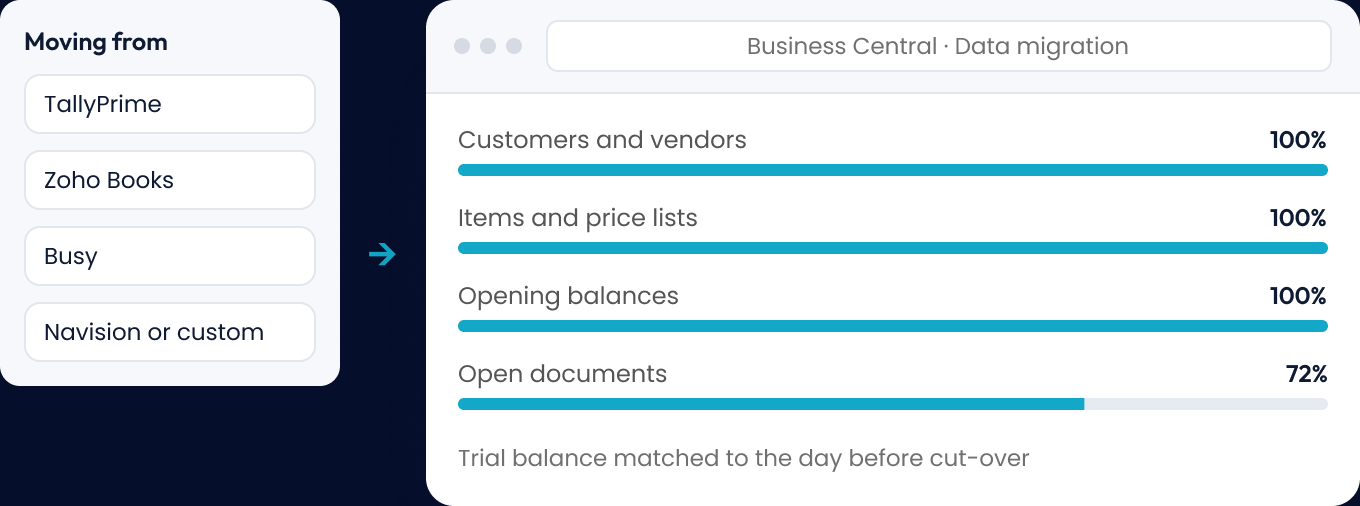

Illustration with sample data

ImplementationMigration and UpgradeSupportConsultingIntegrationIT Advisory

Microsoft Solutions Partner for AI Business Solutions (formerly Business Applications) and Modern Work. ISO 27001 and ISO 9001:2015 certified.

20+

years in business

100+

Microsoft-certified consultants

100+

clients globally

97%

client satisfaction

What this actually is

A migration is a data project wearing an ERP project’s clothes

Dynamics 365 is a known quantity. Microsoft has shipped and supported it for years and its behaviour is documented. What is not known is what your data will do when it meets it.

Every partner can configure the destination. Far fewer will look properly at the source before quoting, because looking properly is unbillable work that tends to reveal how much the project will really cost. That is precisely why it should happen first.

A Tally chart of ledgers that grew by accretion over fifteen years. Item codes where meaning lives in the third and seventh characters, applied consistently until 2019. Customers who exist three times because someone abbreviated the firm name differently each time. Godown stock that never quite tied. None of that is unusual, and none of it appears in a demonstration.

The consequence is a simple discipline: nothing gets an estimate until it has been measured. That is a harder sell in a first conversation than a confident number, and it is the reason the number that follows tends to hold.

Where migrations fail

Four patterns, and we have seen all of them

Data assumed clean. Nobody profiles it. The duplicates, orphans and items with no cost arrive on cutover weekend, where fixing them is far more expensive.Mapping decisions deferred. The chart of accounts needs restructuring, nobody wants to own it, so the load runs against the old one and gets redone.One load, no rehearsal. A single run on the cutover weekend with no earlier pass. Everything found on the night is found under time pressure.No agreed definition of correct. If nobody said in advance what the migrated data must reconcile to, there is no way to declare it finished. It just stops.
Before quoting

What we measure, and why it changes the price

This is a measurement exercise, not a conversation. It produces a report with counts in it, and those counts are what a migration estimate should be built from.

01

Volume and shape

Record counts by type, growth rate and how far back the history goes. Volume alone rarely drives cost. The spread of exceptions inside it does.

02

Duplicates and orphans

Customers and vendors existing more than once under near-identical names. Transactions pointing at masters that no longer exist. Both need a decision before anything loads.

03

Ledger structure

How many ledgers, how many are still posted to, and how much of the grouping is doing work that dimensions should be doing. Usually the largest redesign decision.

04

GSTIN and entity structure

How many registrations, in how many states, and how they relate. This decides whether the target is one company, several, or a dimension model, and it is expensive to change later.

05

Stock and godowns

Item masters, units, batch and serial usage, godown structure and whether the physical count has ever agreed with the system. That last answer changes the plan.

06

Integrations, including forgotten ones

The scheduled export somebody set up years ago that nobody owns. Undiscovered interfaces are one of the most reliable ways to break a cutover.

Method

Nothing reaches the new system until it reconciles

Data moves in a defined order through a gate that either passes it or sends it back. What fails goes back for correction and runs again. It does not get written anyway.

1

Profile

Counts, duplicates, orphans and exceptions measured against the source before any mapping is designed.

OutputData profile report

2

Map

Every source field to a target field, with the transformation rule written down and the exceptions named.

OutputField mapping document

3

Transform

Cleansing decisions applied as code, so the same rule produces the same result on every subsequent pass.

OutputRepeatable transformation scripts

4

Reconcile

Trial balance, debtor and creditor ageing, stock quantity and value by location, open document counts. Pass, or return.

OutputReconciliation report against agreed totals

5

Rehearse

Timed dress rehearsals until the elapsed time is known, which is what turns a cutover window into a plan rather than a hope.

OutputRehearsed cutover runbook

Pass one exists to fail

The first run is a discovery exercise. Its job is to surface what breaks while there is still time to decide what to do about it, not to succeed. A migration plan that treats the first load as the real one is a plan that has not budgeted for what it will find.

GST return cycles, TDS deposit dates and audit timing constrain the window. In India that usually means a quarter or financial year boundary, and it is planned before the project plan is written, not fitted around it afterwards.

History that does not migrate goes somewhere accessible, not into a folder of exports. Your statutory retention obligation does not move just because your ERP did, and an archive nobody can query is not an archive.

Pathways

Where are you moving from?

The system you are leaving determines the plan far more than the one you are moving to.

Most common

Tally

Masters and opening balances migrate cleanly enough; extraction is rarely the difficulty. The real work is the ledger-to-chart redesign, because a Tally chart of ledgers built by accretion over many years usually needs restructuring into dimensions rather than a like-for-like copy. The other decision is how much voucher history genuinely needs to come across, against how much sits better in a read-only archive.

Godown-wise stock is profiled explicitly, because it rarely ties to the system before cutoverLedgers that exist only because Tally could not do something another way are flagged during profiling, not carried across by default

Peer product

SAP Business One

A structured source with a real data model, which helps profiling considerably. The decisions here are less about extraction and more about judgement: what to carry forward as designed, and what was only ever a workaround for a Business One limitation that Business Central does not share. Add-ons bolted onto B1 over time are worth a specific look, because their logic sometimes belongs in standard functionality rather than a rebuilt extension.

Chart of accounts and dimension structures usually map with fewer surprises than an accounting-package sourceExisting customisations are reviewed individually rather than assumed to be needed

Upgrade path

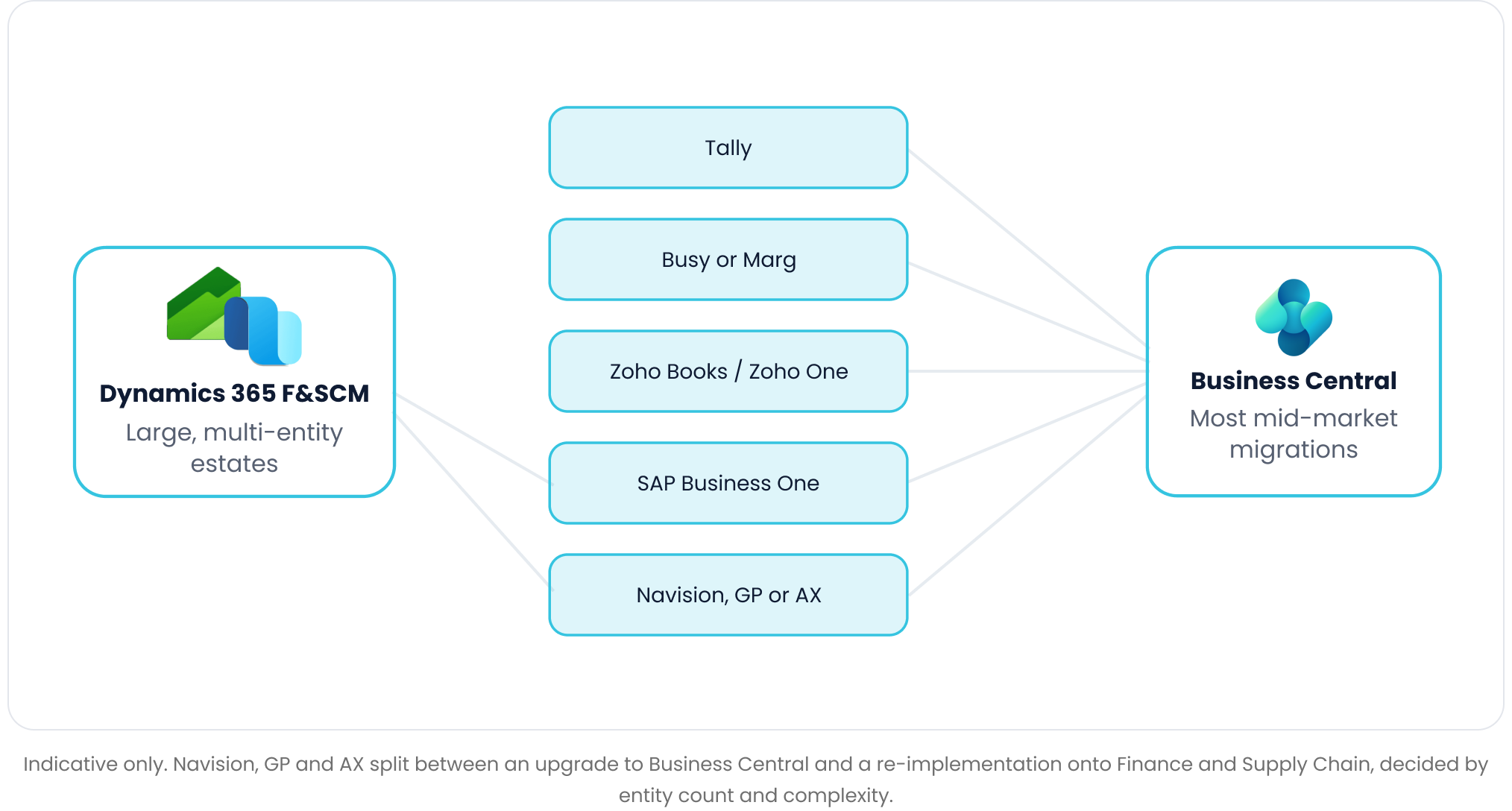
Dynamics NAV or GP

Sometimes this is an upgrade, and sometimes it is a re-implementation, and which applies depends on how heavily the existing system was modified. A clean, close-to-standard NAV environment often upgrades in place. A heavily customised older build, where years of code sit on top of a version Microsoft no longer patches, is frequently cheaper and safer to migrate as a fresh Business Central implementation than to carry forward.

Every existing customisation is assessed for whether it survives, gets rebuilt, or is retired because standard now covers itMulti-entity NAV or GP estates are the most common candidates for Dynamics 365 Finance and Supply Chain instead

Hardest data

Busy, Marg or a custom system

Usually the hardest extraction and the clearest business case, in that order. Smaller accounting packages and in-house systems built years ago rarely export in a structured way, and a custom system may have no export path at all beyond a database dump somebody has to make sense of. Profiling matters most here, because the estimate genuinely cannot be written without it.

Database-level extraction is common where no standard export exists, and it is scoped as its own stepThe business case is usually the strongest of the four, because the pain being solved is rarely subtle

Lead magnet

Get the migration checklist

A Tally to Business Central migration checklist covering masters, opening balances, open documents and GST set-up.

Common questions

What people ask about ERP migration

Have a question that is not covered here? Send it to a consultant and you will get a reply within one working day. The full list is on our FAQs page.

How do you migrate from Tally?

By profiling it first. Tally exports masters, vouchers and opening balances cleanly enough; the difficulty is the decisions that follow: which ledgers map to which accounts in a redesigned chart, what happens to godown-wise stock, and how many years of vouchers genuinely need to come across. We produce a data profile with counts before writing an estimate.

Less than most people assume. Most organisations migrate masters, current balances and a defined number of prior periods, then keep the rest in a read-only archive. Moving twelve years of transactional history into a new ERP usually costs more than it returns. The statutory retention obligation sits with you regardless of which system holds the data, so the archive has to stay real and accessible.

It generally stays where it is. Returns already filed are filed; they live with the portal and your records. What matters going forward is that the new system produces correct data from the cutover date and that you can still answer a query about a prior period, which is what the archive is for.

Almost always at the start of a financial period, and in India that usually means aligning to a quarter or the financial year rather than a calendar convenience. GST return cycles, TDS deposit dates and audit timing all constrain the window, so this is a planning conversation that happens before the project plan is written.

Because correct is defined in advance, in writing, as a set of reconciliations: trial balance to trial balance, debtor and creditor ageing, stock quantity and value by location, and open document counts. Every pass produces a reconciliation report against those figures. Anything that fails goes back for correction and runs again.

For operational areas, sometimes and briefly. For the general ledger, no. You cannot run two ledgers as the system of record and expect either to be right, and in an Indian context you also cannot file from two sources. The financial cutover is a single step, which is exactly why it gets rehearsed.

Client outcomes

Client outcomes delivered by Alphavima

Selected stories from Alphavima’s global client base in North America and the UK, delivered on the same Microsoft platforms we implement for businesses in India.

01 / 03

Equipment and fleet distribution · USA

Zero downtime during a full ERP migration, with 100% data integrity validated

ERP data migration and integration

Custom Truck One Source

ETL pipelinesData validation and reconciliation

Wholesale distribution · USA

99%+ inventory accuracy after barcode warehouse management

Barcode warehouse management for a national distributor

Confidential client

Business CentralWarehouse ManagementEDIPower BI

Discrete manufacturing

Production planning cycle cut from weeks to days

Production planning rebuilt on Business Central

Confidential client

Business CentralPower AppsPower BI

Next step

Find out what your data will actually do

A migration assessment profiles your source and produces counts, not opinions. That report is what a credible estimate is built from.