


 Dynamics 365Customer Engagement

Home/Services/Implementation
Implementation
Business Central and Dynamics 365 implementation in India
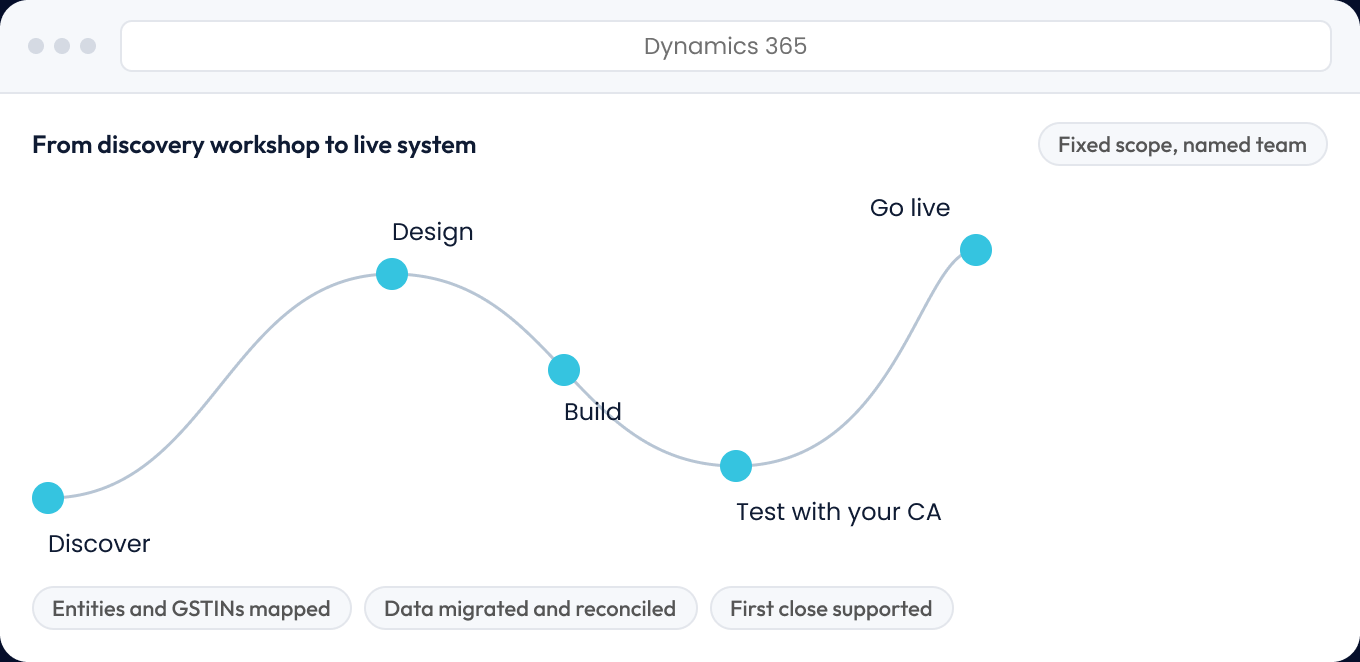
An implementation is a series of decisions taken in the right order. We phase it around your statutory calendar rather than a generic template, and no stage starts before the previous one is signed off.
 Eight stages, phased around GST returns, TDS dates and your year endYour team runs a full period close, including a GST cycle, before go liveWhat you provide is stated as clearly as what we deliver
ImplementationMigration and UpgradeSupportConsultingIntegrationIT Advisory

Microsoft Solutions Partner for AI Business Solutions (formerly Business Applications) and Modern Work. ISO 27001 and ISO 9001:2015 certified.
20+
years in business
100+
Microsoft-certified consultants
100+
clients globally
97%
client satisfaction
Where projects go wrong
Implementations rarely fail on the software
Dynamics 365 works. Microsoft has shipped and supported it for years and the functionality is not in doubt. When an ERP project goes badly in India, the cause is almost always somewhere else.
A deferred decision. The ledger structure needs rethinking, nobody wants to own it, so configuration starts against the old one and gets redone later, at far greater cost. Or the multi-GSTIN modelling question is left open because it feels technical, and it turns out to drive the entire close process.
Data assumed clean. Nobody profiles it. The duplicate vendors, the items with no cost and the godown balances that never quite tied all arrive on cutover weekend, where they are far more expensive to fix.
Testing done by the wrong people. If your finance team has not run a full period close including a GST cycle in the new system before go live, you have not tested it. You have watched a demonstration.
None of this is an argument against implementing Dynamics 365. It is an argument for treating the decisions above as the actual project, and the configuration screens as the part that follows once they are made. A plan that names who owns each decision, and by when, is worth more than a plan with a more impressive Gantt chart.
Worth asking
Warning signs in a proposal
A go-live date before anyone saw the data. A date offered in the first meeting is a sales position, not an estimate.Migration priced as one line. If it is a single figure with no profiling behind it, that figure is a placeholder and it will move.No named people on your side. If the plan does not say who from your team is needed and for how many days, that time has not been budgeted.Go live in the week of a return. If the plan ignores your GST and TDS calendar, it was written to a template from another market.
How it runs
Eight stages, and you always know which one you are in
No stage starts before the previous one is signed off. That is deliberate. Most ERP projects go wrong when configuration begins while the design is still being argued about. Duration depends on your entities, states and data condition, and your scoped plan states it in writing; a single-entity, one-to-three-state implementation runs a very different length of time from a multi-GSTIN manufacturer.
1
Discover
Current systems, processes, data condition, entity and GSTIN structure, integrations, reviewed with the people who do the work.
OutputSigned discovery report
2
Design
Target ledger structure, dimensions, GSTIN modelling, approval flows and reporting decided and written down.
OutputSigned design document
3
Configure
Set up against the signed design, with extensions only where standard functionality genuinely will not do.
OutputConfigured sandbox
4
Migrate
Masters, then opening balances, then open items, reconciled at each pass against agreed totals.
OutputReconciliation report
5
Integrate
GSP for e-invoicing, banking, marketplace and plant feeds connected, with failure handling defined rather than assumed.
OutputTested interfaces
6
Test
Your team runs a full period close and a GST cycle, not a scripted demo somebody else drives.
OutputSigned user acceptance record
7
Go live
A rehearsed cutover aligned to a period boundary, with a rollback position and named people on call.
OutputLive system
8
Support
We stay close through the first month ends and the first full GST cycle, which is when the real questions arrive.
OutputHandover to the support agreement
Week-by-week timing is set out in your scoped proposal after discovery, because it depends on your entities, your data and how many states you file in, not on a generic template.
Roles by stage
Who does what, stage by stage
Named against the eight stages above, so nobody discovers their own workload in week six. Your project sponsor approves at every gate; the two columns below show who leads the work itself.
Alphavima leads
Discover: leads workshops, drafts the reportDesign: leads design, documents decisionsConfigure: leads configuration and any extensionsMigrate: leads profiling, mapping and loadIntegrate: leads build and failure-handling designTest: prepares scenarios and tracks defectsGo live: leads the rehearsed cutoverSupport: leads issue resolution and release checks
Your team leads or provides
Discover: process owners and system accessDesign: ledger structure, dimensions, GSTIN modelConfigure: reviews and signs off against the designMigrate: cleansing rules, approves reconciliationIntegrate: confirms GSP, bank and marketplace credentialsTest: leads, runs a full period close and GST cycleGo live: provides sign-off authority on the nightSupport: reports issues through the agreed channel
Testing is marked differently because it is the one stage your team leads rather than reviews: a period close and a GST cycle cannot be run on your behalf and still count as tested.
Both sides
What you provide, stated as clearly as what we deliver
Implementations are not delivered to you. They are delivered with you. Most plans we are asked to review describe only the partner side, which is exactly where the surprise comes from.
01
We deliver
- Process walkthroughs and a fit-gap analysis
- A data profile report on your current system, with counts
- A target design document with the decisions written down
- Configuration, extensions and integrations to that design
- Test environment, scenarios and defect tracking
- Training, written process guides, and a rehearsed cutover
02
You provide
- Access to the people who actually run the processes
- Decisions on ledger structure, dimensions and GSTIN modelling
- Sign-off from someone with the authority to give it
- Data cleansing decisions, and somebody to make them
- Your finance team running a full period close and a GST cycle
- Discipline about change requests during the build
Before you sign
Questions that come up while scoping an implementation
Most of these are settled during discovery. Reading them first means discovery answers questions you already understand rather than ones you are hearing for the first time.
We already have a chart of accounts we like. Does it survive the move?
Often in large part, but rarely unchanged. Business Central carries dimensions, so a cost centre, a project or a state can be an attribute of a posting rather than a branch of the chart itself. The design stage is where we test your existing structure against that model and decide what moves as it is, what becomes a dimension, and what genuinely needs restructuring.
We run on a hybrid of Tally and Excel. Does that change the plan?
It changes discovery more than it changes the eight stages. The Excel processes have to be found and named, because they are usually carrying logic nobody wrote down anywhere else: a costing adjustment, a scheme calculation, a consolidation step. Each one gets a decision during design: configure it in Business Central, automate it on Power Platform, or leave it as a genuine exception with a documented reason.
We need e-invoicing live from day one. Does that add time?
It adds a dependency more than it adds time: the GSP subscription and the credentials it needs have to exist before the Integrate stage can complete, and that is a commercial step on your side we flag during discovery rather than discover during testing. Once connected, e-invoice JSON with IRN and the signed QR code are tested in the same cycle as GST and TDS.
Our data has never been formally audited. Is that a blocker?
No, but it changes what discovery and migration look like. Profiling exists precisely to surface duplicate masters, items with no cost, and godown balances that never quite tied, while there is still time to decide what to do about them. Finding these during discovery is normal. Finding them on cutover weekend is the failure mode this whole methodology is built to avoid.
Can we phase manufacturing in later, after finance and sales go live?
Yes, and it is a common and sensible sequence for a business moving off Tally, where finance and stock discipline usually needs to land first. Business Central Premium licences carry the manufacturing functionality; moving from Essentials is a licence change on the same environment, and BOMs, routings and production planning are then configured as a follow-on phase.
What if we need something that is not in the original design document?
It goes through change control rather than getting quietly absorbed or quietly refused. The request is assessed for effort, schedule impact and whether it genuinely belongs in this phase or after go live. A surprising number belong after go live, and saying so in writing, with the reasoning, is part of keeping the fixed scope meaningful.
Lead magnet
Get the implementation scoping checklist
A short checklist covering entities, GSTINs, data condition and integrations, the same inputs discovery uses to phase your plan around your statutory calendar.
Common questions
What Indian buyers ask about implementation
Have a question that is not covered here? Send it to a consultant and you will get a reply within one working day. The full list is on our FAQs page.
What happens if a stage is not signed off before the next one starts?
It does not start. Every one of the eight stages ends with a signed deliverable, listed against the methodology on this page, and the next stage does not begin until that sign-off exists. That discipline, more than any tool, is what keeps a go-live date real.
How much of our own time will it need?
More than most proposals admit, and we would rather you budgeted for it than discovered it. Discovery needs the people who actually run the processes. Design needs someone who can settle a chart of accounts question and a GSTIN modelling decision. Testing needs your finance team to run a full period close including a GST cycle, not watch one. The day commitment by phase is set out during scoping.
How do you phase around GST returns and year end?
By treating them as fixed and planning around them, because they are. Configuration and testing avoid the days when finance cannot absorb anything, cutover aligns to a period boundary, and go live does not land in the week of a return.
Do we have to customise?
Usually far less than expected. When a requirement is not covered by standard functionality there are four answers in order of cost: change the process, configure standard, build it on Power Platform beside the ERP, or write an AL extension inside it.
Who does the work, and where are they?
The delivery team is in India, working with clients nationally. Most of an implementation runs remotely; the phases that genuinely benefit from people in the room, typically discovery and go live, are scoped that way. You are told which consultants are on your project rather than assigned a pool.
What happens after go live?
We stay close through the first month ends and the first full GST cycle, which is when the questions that actually matter arrive. After that the arrangement moves to a support agreement covering functional and technical support, configuration changes and the twice-yearly Microsoft release cycle.
Client outcomes
Client outcomes delivered by Alphavima
Selected stories from Alphavima’s global client base in North America and the UK, delivered on the same Microsoft platforms we implement for businesses in India.
01 / 03
Discrete manufacturing
Production planning cycle cut from weeks to days
Production planning rebuilt on Business Central
Confidential client
Business CentralPower AppsPower BI
Wholesale distribution · USA
99%+ inventory accuracy after barcode warehouse management
Barcode warehouse management for a national distributor
Confidential client
Business CentralWarehouse ManagementEDIPower BI
Construction
Committed and actual job costs visible every day, not at closeout
Daily job costing for a construction business
Confidential client
Business CentralField ServicePower Apps
Next step
Scope your Dynamics 365 implementation
Tell us what you run today and what is forcing the change. You will get a sequence, a shape and the risks in your data, before anyone talks about a price.